What’s on Kate’s Desk?

Kate Bateman is one of my colleagues in the Howard County Public School System. We recently did one of my favorite things, which is to eat hot pot and geek out over stationary. Afterwards, Kate showed me an image of her amazing desk setup. I was inspired. I thought, wouldn’t it be cool to share more of people’s workflows and setups on this blog?

Kate agreed to be a part of my experiment in a new series on here, “What’s On Your Desk?”

I prepped some questions for Kate, she answered and provided pictures.

Kate, take it away. What’s on your desk?


My name is Kate Bateman. I am a former professional orchestral flutist, but gave that up to spend time with The Youths at Mount View Middle School, where I teach band and general music. This is my 8th year as a teacher.

I also have a stupid amount of hobbies- I speak Korean conversationally, I love painting, I dabble in photography, I read a lot, I love cooking (when I have the time to enjoy the process of it), and if I have the money, I will travel any chance I get.

What are a few of the things on your desk that make you the most productive?

One is my planner (a Hobonichi weeks), which keeps me organized when I have a million things going on. I got the version with extra blank pages in the back, so I also use it to keep track of to-dos both in and out of work. It’s old school, but it works for me.

The other is a simple analog timer. Whenever I need to sit down and get something done but am feeling particularly unmotivated, I stick the timer on for 15 minutes at a time, take a break for 5 minutes, then rinse and repeat until I can’t concentrate anymore.

What computing devices do you always have on your desk? How do they fit into your workflow?

Just my old iMac and my iPad. I use Google for most of my work, along with a few other apps to help with organization (Craft and Goodnotes being the main two). These can all be accessed easily from any desktop or my iPad, so I leave my school-provided chromebook at work. It’s clunky anyway.

What other tools do you keep close by?

Everything else is SUPER low tech! I almost feel like I’m betraying you, Robby.

I have all five of my fountain pens close by. My favorite, and most beloved, is my Pilot Vanishing Point, which was worth every (exhorbitant) penny because I use it all day, every day. All my pens feel different to use and they all have different color Pilot Iroshizuku inks in them. I use my Vanishing Point the most, but I also reach for others depending on my mood.

I also have all of my journals within easy reach to the side on this Ikea cutting-board-turned-bookshelf. I have my daily 5-year journal, my Commonplace journal (where I write down things I’ve read, quotes, lyrics, notes from therapy, anything thought-provoking that I want to come back to later), my sketchbook, my journal for my National Board Certification classes, and my notebook where I take all of my notes in my Korean lessons.

I “built” this desk specifically out of an Ikea butcher block countertop, a set of Ikea Alex drawers, and a little cube with shelves specifically to store my art supplies and stationery, while still giving me a lot of room to spread out. All of my stationery and art supplies are within easy reach, they’re just hidden in the drawers (except for my oil and gouache paintbrushes).

Are there any workflows that are effective for your productivity these days?

Specifically here, at this desk? Nah.

At school though, I start every morning by writing down what we actually got done the day before in each class, and then quickly making a new plan for each class for that day. It gives me a chance to see how much I still have to plan, if I need to make copies of materials, or prepare the classroom in any way, etc.

Usually once I get through period 1, I start my to-do list. It’s mostly a brain dump- what do I still need to get through the day? What do I need to get through the rest of the week? Who do I need to contact about which concerns or questions?

I teach five completely different classes every day, and each day I see around 150 students, so having the brain dump time lets me see everything all at once, and enables me to prioritize. As someone wise (Ben Denne, a wonderful HCPSS colleague) once said, working quickly isn’t really working quickly, it’s just about putting out the biggest fire first.
How does your work change when you are mobile, or away from this setup?

The type of work I do is definitely different. When I am at my desk at school, I often am shuffling a lot of papers, and several binders with my band, sectional and general music lesson plans, attendance sheets, and resources. Work at school is a lot of admin- putting grades in, emails, grading, updating Canvas etc. This is also the work that is a lot easier to do when I’ve been in front of kids for several hours straight and don’t necessarily have a lot of gas left in the tank, mentally.

I feel like I do a lot more of my “big picture” planning when I’m at my home desk. If I need to sit down and plan an entire unit, rethink part of a unit, write playing exercises, or re-write a part, it’s much easier to do it here, farther removed from the day-to-day chaos of school.

What’s something on your desk that is unique to you? Why do you have it?

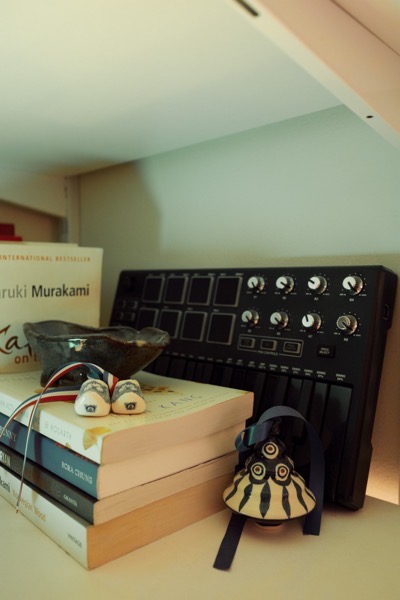
I love my Ikea pegboard behind my computer. It has a bunch of little trinkets and things I’ve picked up from various travels. The majority are from Korea- a photobooth strip from Seoul with my friends Seungwon and Seungmin; a cloth from one of the lovely host I stayed with in Itaewon; a bookmark from the Dae-O bookstore in Seoul (a pilgrimage for fans of BTS’s leader RM); several keychains and postcards. I also have a postcard from Bangkok, where I went with my coworkers/family members Matt and Jon and Randy and a tile from the Palais des Papes in Avignon, France, where I went this summer with my wonderful friends Justine and Lewis.

The little jar which holds my gel and ball point pens is also special; it’s the jar from the dip that my friends Caitlin and Danny brought to a New Year’s party we hosted a couple years ago. I have a figurine from a different trip to Korea that brings back memories of Seoul and Busan with my friends Nick and Nicole. I also love my three-legged pig (which symbolizes goodwill and luck) from my friends Charlie and Carey, who I met through DnD.

I have a lot more trinkets from different trips and times of my life everywhere in my home. Every time I see these things, I’m reminded of how lucky I am to have had made such fantastic memories, and to have made them with wonderful people.

Twenty Years on this Journey – Technology in Music Education

Chris Russel wrote some reflections on blogging for 20 years about music, education, and technology.

This part caught my attention…

Twenty Years on this Journey – Technology in Music Education:

What has also surprised me is how technology in our field, music education, has been in a holding pattern, even before COVID. The deep dive into the use of devices during COVID has resulted in a push against the use of technology by parents and teachers alike, but the technological slowdown started before that.
Keep reading here…

My gut reaction to reading this was to remember my own excitement for tech in 2005. So much hardware and software was on the verge of a breakthrough in democratizing the creative process–making things that used to be expensive, difficult, and professional more affordable, consumer-friendly, and personal. I was primarily excited by how easily I could make and share music.

When I think about what we’re being told are the breakthroughs of 2025, it’s all AI. The positioning of AI as some sort of “next big thing” still feels like an answer in search of a question. AI, and the developments of the early 2000’s, can both make things easier, but so much of what’s emerging today feels pro-capital and anti-curious.

Definitely follow Chris Russel’s awesome work. He has helped me level up my ukulele teaching chops in recent years, and this conversation might be a good starting point for some of that if you are interested.

Teaching Intonation with Tonal Energy – OMEA 2025

CleanShot 2025-02-06 at 10.43.27@2x.

I am thrilled to be presenting four sessions at the Ohio Music Educators Association Professional Development Conference this weekend! My fourth session focuses on teaching intonation in the music classroom with support of technology.

If you’d like to attend, the session is on February 8 at 11 AM. If you’re already here or have attended, thank you for coming!

This post serves as a resource for session notes, including links to the primary tools I mention, and a complimentary podcast episode.

Complimentary Podcast Episode:

Where to Find Me

Subscribe to the Blog…RSS**** | Email Newsletter

Subscribe to the Podcast in…Apple Podcasts**** | Overcast | Castro | Spotify | RSS

Support My Work

Become a Patron!

Session Outline and Links to Resources Mentioned in the Session

Teaching Intonation

Philosophy

  • Prioritize these…
    • Tone
    • Intonation
    • Balance/Blend
    • Melodic Accuracy
    • Rhythmic Accuracy
    • Expression/Phrasing
    • Technique/Articulation
  • Sound Over Sight
    • If we are asking students to use their ears, then why are we having them use their eyes?
    • Natural Learning – think about how children learn to speak. Through modeling from parental figures, constant repetition, and encountering these repetitions in various contexts.
    • Electronic tuners can only tune intervals of unisons and octaves accurately.
    • We are used to hearing the piano in its slightly “out-of-tune” tempered state.
  • Interval Adjustment
    • Pure intervals have varying degrees of adjustment from tempered intonation to make them in tune.
    • Scale Degree | Adjustment
      • 1 | 0
      • 2 | +3.9
      • 3 | -13.7
      • 4 | -2.0
      • 5 | +2.0
      • 6 | -15.6
      • 7 | -11.7
      • 8 | 0
  • We must teach our students to HEAR when something is out of tune by listening for beats. But how?
    • Resonant intonation is the result of two other important features: superior tone and balance.
    • Good tone comes first.
    • Learning balance is difficult in a room by yourself.
    • Use of an electric drone helps.
    • Turn the drone up to a level that equals the student.
    • Song based learning that utilizes lots of simple melodies in standard keys teaches students to understand basic consonance and dissonance.
    • Lots of repetition!!!
    • Patients!
    • Reinforce that one success does not mean that everything will be in tune from here on out.
    • Don’t strive for a perfect intonation system. Resist teaching students the theory of intervals and focus on them hearing consonance and dissonance through listening to the relationships of intervals.
    • Once you know what a 5th sounds like, you can tune it anywhere.
    • Avoid technical talk unless something is absolutely in a students way.
  • Daniel Kohut – Musical Performance: Learning Theory and Pedagogy
    • Superior Concept
    • Relaxed Concentration
    • Focused Awareness
  • Reasons teachers give up on teaching intonation this way…
    • Fear of other areas of musical performance failing – wrong notes, rhythm, poor technique, inability to execute musically. The solution to this – pick easier music!!!
    • Abstract nature of these skills make them less concrete to student minds and harder to teach.
    • This is a long road. It takes time. But! – the end reward is ultimately better because students own their critical listening skills and now make musical adjustments themselves, even to features in the music that are not tone and intonation related. Each year will have an upswing towards the end. Independent musicianship is the result.

Features of Tonal Energy

  • Overview of each feature and setting – Live Demo
    • Strategies
  • Everything with drone
    • All music taught around tonal centers
    • Students tune down to the tonic most immediately beneath where the majority of their part sits
    • Students write tonal centers in their method books and concert music
  • Analyze mode – Students practice scale patterns and songs in this sequence…
    1. Visual and aural feedback
    2. Aural feedback only
    3. No drone at all
  • Practice Guide

CleanShot 2022-01-09 at 12.45.41.png

  • You can balance to the drone

    Tell students to match the volume of the drone at various levels.

  • Play along melodies with students on a keyboard or on the display

CleanShot 2022-02-03 at 18.21.25@2x.png

A midi keyboard like the Xkey can play certain key areas in tune perfectly and can automatically tune chords to just intonation. Combined with an iPad, this is like owning a Yamaha Harmony Director.

CleanShot 2022-02-03 at 18.21.47@2x.png

Lightly Row with Tuning Drones

Recording Tonal Energy into GarageBand with Inter-App Audio

Embellishing the Drone Track with Drums

Embellishing Lightly Row

Scale Exercise Play-Along Tracks with Trap Beats – Promotional Video

Image.png

Image.png

CleanShot 2022-02-03 at 18.23.30@2x.png

  • More Resources

Extra Show Notes from the Podcast Episode:

App of the Week

Album of the Week

Tech Tip of the Week

Communication and Collaboration Apps For Music Teams – OMEA 2025

CleanShot 2025-02-07 at 11.52.20@2x.

I am thrilled to be presenting four sessions at the Ohio Music Educators Association Professional Development Conference this weekend! My third session focuses on communication and collaboration apps for music teams.

If you’d like to attend, the session is on February 8 at 9:30 AM. If you’re already here or have attended, thank you for coming!

This post serves as a resource for session notes, including links to the primary tools I mention, and a complimentary podcast episode.

Complimentary Podcast Episode:

Where to Find Me

Subscribe to the Blog…RSS**** | Email Newsletter

Subscribe to the Podcast in…Apple Podcasts**** | Overcast | Castro | Spotify | RSS

Support My Work

Become a Patron!

Buy me a coffee

Links to Things Mentioned in the Session

Image.png

Image.png

Image.png

Image.png

Image.png

Image.png

Image.png

Image.png

Image.png

Image.png

Working with Digital Scores – OMEA 2025

CleanShot 2025-02-06 at 10.33.12@2x.

I am thrilled to be presenting four sessions at the Ohio Music Educators Association Professional Development Conference this weekend! My second session focuses on working with digital scores.

If you’d like to attend, the session is on February 7 at 5 PM. If you’re already here or have attended, thank you for coming!

This post serves as a resource for session notes, including links to the primary tools I mention in the session.

Apps for Scanning:
Simple Scan
Scanner Pro
– Apple Notes/Files

Apps for Scanning Notation
– Scoring Notes Article: Scanning the Current OMR Landscape
Sheet Music Scanner
Newzik
Soundslice
PlayScore 2
SmartScore 64
ScanScore 3

Apps for Managing Files
– Files App
Dropbox
Google Drive
Documents
Evernote

Apps for Working with Scores:
forScore
unReal Book
Newzik

Notes on forScore:
forScore Mac App Review
Creating indexes with forScore
The fastest way to get music into forScore
forScore Automation Links

My Book:

Digital Organization Tips for Music Teachers

Buy on Amazon | Buy on Oxford University Press

View the video trailer

Digital Organization Tips for Music Teachers – OMEA 2025

CleanShot 2025-02-05 at 15.26.07@2x.

I am thrilled to be presenting four sessions at the Ohio Music Educators Association Professional Development Conference this weekend! My first session focuses on getting digitally organized in the music classroom.

If you’d like to attend, the session is on February 7 at 9:30 AM. If you’re already here or have attended, thank you for coming!

This post serves as a resource for session notes, including links to the primary tools I mention and a complimentary podcast episode.

Subscribe to the Blog…
RSS | Email Newsletter

Subscribe to the Podcast in…
Apple Podcasts | Overcast | Castro | Spotify | RSS

Support Music Ed Tech Talk

Become a Patron!

Buy me a coffeeBuy me a coffee

Show Notes:

Please don’t forget to rate the show and share it with others!

METT Episode 82 – Beta Boys, with Will Kuhn

#72 – Secrets to Sustainable Careers, with Elisa Janson Jones

Elisa Janson Jones joins the show to talk about self-care, social media, and our favorite apps for being productive and healthy.

Subscribe to the Blog…
RSS | Email Newsletter

Subscribe to the Podcast in…
Apple Podcasts | Overcast | Castro | Spotify | RSS

Support Music Ed Tech Talk

Become a Patron!

.bmc-button img{height: 34px !important;width: 35px !important;margin-bottom: 1px !important;box-shadow: none !important;border: none !important;vertical-align: middle !important;}.bmc-button{padding: 7px 15px 7px 10px !important;line-height: 35px !important;height:51px !important;text-decoration: none !important;display:inline-flex !important;color:#ffffff !important;background-color:#000000 !important;border-radius: 5px !important;border: 1px solid transparent !important;padding: 7px 15px 7px 10px !important;font-size: 20px !important;letter-spacing:0.6px !important;box-shadow: 0px 1px 2px rgba(190, 190, 190, 0.5) !important;-webkit-box-shadow: 0px 1px 2px 2px rgba(190, 190, 190, 0.5) !important;margin: 0 auto !important;font-family:'Arial', cursive !important;-webkit-box-sizing: border-box !important;box-sizing: border-box !important;}.bmc-button:hover, .bmc-button:active, .bmc-button:focus {-webkit-box-shadow: 0px 1px 2px 2px rgba(190, 190, 190, 0.5) !important;text-decoration: none !important;box-shadow: 0px 1px 2px 2px rgba(190, 190, 190, 0.5) !important;opacity: 0.85 !important;color:#ffffff !important;}Buy me a coffeeBuy me a coffee

Thanks to my sponsors this month, Scale Exercise Play Along Tracks.

Show Notes:

Please don’t forget to rate the show and share it with others!

Holiday Gift Guide 2022, with David MacDonald and Craig McClellan

I’ve got a new podcast episode out, and while it’s probably not in time for most of your shopping, the stuff we discussed are amongst my favorite things of 2022 and are certainly great ideas to treat yourself with down the road, if not sooner.


Show regulars Craig McClellan and Dr. David MacDonald join the show to talk about stuff we like.

Subscribe to the Blog…

RSS | Email Newsletter

Subscribe to the Podcast in…

Apple Podcasts | Overcast | Castro | Spotify | RSS

Support Music Ed Tech Talk

Become a Patron!

Buy me a coffee

Thanks to my sponsors this month, Scale Exercise Play-Along Tracks.

Show Notes:

Music Ed and Tech News

Books

Software

Services

Hardware and Gadgets

Bags, Pens, and other Misc stuff

The Pen Addict Podcast

Pilot Metropolitan – 6 Cartridges https://www.jetpens.com/Pilot-Iroshizuku-Shin-kai-Ink-Deep-Sea-6-Cartridges/pd/34517)

JetPens.com – Pilot Iroshizuku Shin-kai Ink (Deep Sea) – 6 Cartridges

Rhodia Notepad

Plotter

Tom Bihn Bags

App of the Week:

Robby – Spring for Twitter

David MacDonald – Cleanshot X / Spaceteam (Board game version)

Craig McClellan – Timery

Music of the Week:

Robby – Carly Rae Jepsen: The Loneliest Time

David MacDonald – Béla Fleck, Mike Marshall and Edgar Meyer: Uncommon Ritual

Craig McClellan – Bonny Light Horseman: Rolling Golden Holy

Tech Tip of the Week:

Robby – Curating your social media experience

David MacDonald – Firefox add-on: Display Anchors https://addons.mozilla.org/en-US/firefox/addon/display-_anchors/

Craig McClellan – Focus Mode Updates

Where to Find Us:

Robby – Twitter | Blog | Book

David MacDonald – Twitter | Website

Craig McClellan – Twitter | Website

Please don’t forget to rate the show and share it with others!

Cool Kids Play The Glockenspiel -> Ivan Trevino’s Music for the Young Percussionist

I have so much admiration for anyone throwing all of their composing creativity into writing music for young musicians.

Ivan Trevino is doing just that with his new collection of pieces for young percussionists. Read more below. My favorite title in the collection is Cool Kids Play The Glockenspiel.

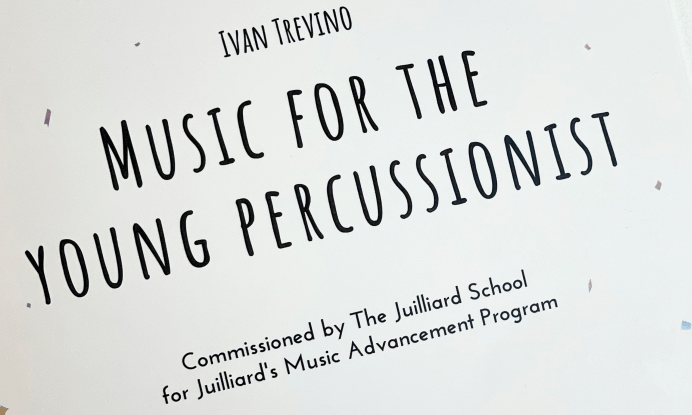
MUSIC FOR THE YOUNG PERCUSSIONIST – Ivan Trevino

MUSIC FOR THE YOUNG PERCUSSIONIST (2022) was commissioned by The Juilliard School for Juilliard’s Music Advancement Program. The collection features 12 short pieces for snare, mallets, timpani, and multi-aux, and was written with the early – late high school percussionist in mind. In my experience, the music that young musicians experience and study can have a profound impact on their relationship with music. Rather than writing these pieces as a step towards conservatory, I wrote them as a step towards enrichment, with hooks and beats that might resonate with young musicians. While each piece focuses on specific musical and technical concepts, they were also written through the lens of a songwriter who enjoys writing tunes. I hope this spirit rings true for performers of this music.