Blink Session Music: Because Virtual Music Lessons are More Than a Video Chat (Sponsor)

Your virtual music lessons are more than a video chat. You interact over sheet music, tabs, audio, YouTube, videos. Sound quality is more important than a chat with grandma. Using advanced settings must be easy. Then, what about homework, scheduling, getting paid? Everything is important but at times requires using multiples online tools that can get time-consuming and complicated both for you and your student.

Blink Session Music is the most advanced and easy-to-use software for online music lessons. Upgraded sound? Absolutely, but Blink goes way beyond to upgrade your entire online lesson experience and business operations.

Are you stuck using Zoom or Skype? Then you’re stuck with screen share. With Blink Session Music, load sheet music, tabs (with midi), audio or videos you upload, YouTube, all without screen share. Even assign all your music resources as homework.

Using a DAW or virtual mixer to stream your guitar or keyboard? No need with Blink. Stream up to three audio sources, at up to 300kbps mono or stereo. Plus toggle noise suppression off.

Blink Session Music’s features go way beyond the lesson. Schedule, self-schedule, reminders, invoices, take payments, notes, files, homework, learning management, reports, and online lessons, all in the same platform.

Sign up now for Blink’s free plan or take the plunge to a paid plan with more time and features.

Control Alt Achieve covers 40 Google for Education Updates for Summer 2021

Google made some big education announcements last week, including a bunch of education features across their apps.

Control Alt Achieve has a great overview of them. Click below to read more.

Control Alt Achieve: 40 Google for Education Updates for Summer 2021:

Summer is a nice time to take a break and relax, but Google has instead been busy working on new updates and features for schools.

On June 22nd Google hosted their “Anywhere School 2021” event (http://goo.gle/tas21) where they covered loads of announcements concerning 40 updates for Google Classroom, Google Meet, Chrome and Chromebooks, and Google Workspace tools in general.

In case you missed it, or are just trying to review through everything that was shared, see below for a list of all 40 updates that were shared at the event.

On the one hand, many of these features looks great (especially the education streaming feature with YouTube/Google Meet). On the other hand, it is easy to see that some of these features are born out of the needs of virtual/hybrid learning and may not be as useful as schools potentially return to in-person instruction this fall.

That said, it looks like there is plenty in store for Google Classroom users, no matter what teaching environment you may find yourself in this fall.

🎙 Music Ed Tech Talk #27 – Catching Up With Shawna Longo, with Shawna Longo

Shawna Longo joins the show to talk about our hybrid teaching gear, social emotional learning, cloud-based music tools, and our favorite apps/albums/tech tips of the week.

Topics include:

  • COVID hybrid teaching strategies
  • Teaching hardware (on a cart!)
  • Teaching performance virtually
  • social emotional learning
  • music tools in the cloud
  • the Canvas mastery grade book

Show Notes:

Tech Tips of the Week:
Robby – Command+K (or Control+K) will create a hyperlink
Shawna – Mute All for Google Meet | Use AirPod mic as input in Google Meet

App of the Week:
Robby – TIDAL
Shawna – Scannable

Album of the Week:
Robby – Future Nostalgia – Dua Lipa
Shawna – Happiness Begins – The Jonas Brothers

Where to Find Us:
Robby – Twitter | Blog | Book
Shawna – Twitter | Website

Please don’t forget to rate the show and share it with others!

Subscribe to Music Ed Tech Talk:

Subscribe to the Blog

Subscribe to the Podcast in…
Apple Podcasts | Overcast | Castro | Spotify | RSS

“Rehearse Your Ensembles Remotely!” at the MMEA Inservice Conference this Saturday, March 5

Sat 545pm-3.png

If you are a NAfME or MMEA member, please join Maryland at our Inservice Conference this weekend. I will be presenting a session titled Rehearse Your Ensembles Remotely! on Saturday, March 6 at 5:45 pm.

Here is the session description:

Learn the strategies and technologies to run engaging synchronous rehearsals. Engage students visually and speed up your flow using Open Broadcasting Software. Pump the sound video/music/play-along tracks directly through Zoom or Google Meet for a lag-free experience. Explore play along with resources, student reflection with Google Docs, effective camera/mic practices, and have students working collaboratively in synchronous chamber ensembles with Soundtrap! Software discussed includes: Keynote, Google Slides, Loopback, Soundsource, Farrago, AnyTune, Soundtrap, Smartmusic!

🎬 Develop Performance Skills Remotely with Cloud Software

<div class="sqs-video-wrapper" data-provider-name="YouTube" data-html="

“>

I have been meaning to write about “what I have been doing for online learning” since the fall.

This has proven difficult for many reasons, mostly that there is a lot I have been doing and it is all interconnected.

Generally, my planning and technology use has fallen into two categories.

  1. Tech that supports synchronous classes (via Zoom/Google Meet/etc.)
  2. Tech that supports the asynchronous work (via LMS, cloud-based and student-facing software, etc.)

Fortunately, I was invited to present at two music conferences this year, MMEA and TMEA, and each of my accepted sessions has serendipitously aligned with each of those areas.

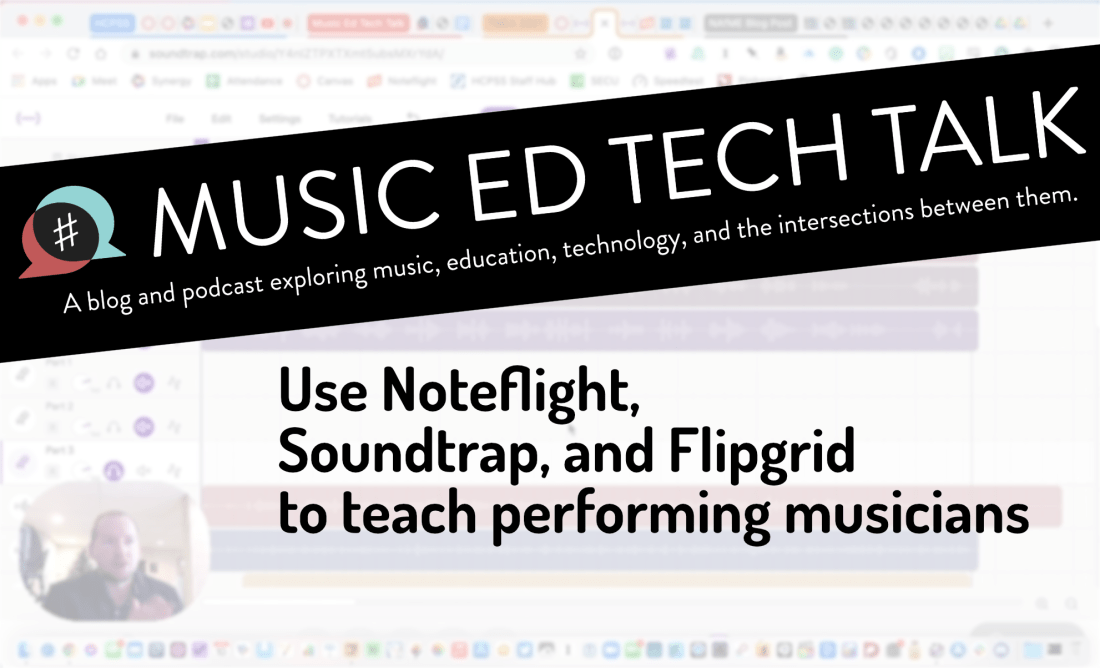
This presentation in the video above is an overview of the asynchronous part. In other words, how I am keeping my virtual instruction focused on playing instruments solo, through student-facing tools like Noteflight, Soundtrap, Flipgrid, and a handful of iOS utility apps.

These strategies were developed while I was teaching virtually but they can just as easily be used in a hybrid or in-person teaching model. I would argue that they are just as valuable in either of those environments.

This presentation was first given at TMEA on Saturday, February 14th, 2021.

You can view the notes to this session here.