I’ve already been getting texts from colleagues asking about yesterday’s iPhone event so I thought I would put some thoughts down here.
I get why this event has everyone’s curiosity levels at 100 every year. Everyone needs a phone. And they want to know which one will be their next. The truth is, iPhones are at a point where they are going to continue to slowly iterate year over year. Major changes are rare.
Every year Apple makes better iPhones than the previous year. In the case of this year, the most notable improvements are to the camera. If you have been holding on to your phone for 2-3 years, this will be a worthy upgrade.
There are four options: iPhone 13, iPhone 13 mini, iPhone 13 Pro, iPhone Pro Max.
Respectively, those could be explained as New Phone (Medium), New Phone (Small), Better New Phone (Medium), Better New Phone (Big).
I can’t tell you which phone to buy but chances are the New Phone is probably good enough for your needs, and what it will really come down to is size and how ready you are to upgrade. The camera is always better on the Pro models, and I have a toddler, so I am getting that model. While some years there is a better camera in the largest sized model, this is not the case this year, so iPhone Pro 13 (non-Max) it is for me. My wife will be getting a mini, which is a really lovely phone if you can stomach the low battery life.
The most attractive thing announced yesterday was probably the new iPad mini that has the new design of the iPad Pros (with flat edges and support for the second-generation Apple Pencil). If you have room for an iPad mini in your life, there is no question, you should get it. This device looks really slick. I am still riding out my iPad Pro 12.9 inch from 2018 and plan to do so for a while, though I am curious about going to the 11-inch pro model sometime down the road. I realize I might miss the larger size for sheet music reading, but I was doing it before there was ever a 12.9-inch size, and I really miss the feeling of holding the smaller size for things like reading and watching video content on the couch. The 12.9 has very much a laptop feeling in my experience. Owning a 12.9 and a mini is tempting but it seems cumbersome to charge and keep up with two iPadOS devices.
There is also a new Apple Watch and it looks like the most boring update ever unless you have a 2+-year-old Apple Watch in which case it will be a really strong update.
I also may consider the new MagSafe wallet attachment that has Find My app integration considering I just lost my wallet at school over as recently as this past weekend.
Last week, Apple aquired classical music streaming service Primephonic. This service is very similar to <a href="https://idagio.com“>IDAGIO which I use and have written about here before.
CUPERTINO, CALIFORNIA AND LONDON Apple today announced it has acquired Primephonic, the renowned classical music streaming service that offers an outstanding listening experience with search and browse functionality optimized for classical, premium-quality audio, handpicked expert recommendations, and extensive contextual details on repertoire and recordings.
With the addition of Primephonic, Apple Music subscribers will get a significantly improved classical music experience beginning with Primephonic playlists and exclusive audio content. In the coming months, Apple Music Classical fans will get a dedicated experience with the best features of Primephonic, including better browsing and search capabilities by composer and by repertoire, detailed displays of classical music metadata, plus new features and benefits.
Primephonic is no longer available for new subscribers and will be taken offline beginning September 7. Apple Music plans to launch a dedicated classical music app next year combining Primephonic’s classical user interface that fans have grown to love with more added features. In the meantime, current Primephonic subscribers will receive six months of Apple Music for free, providing access to hundreds of thousands of classical albums, all in Lossless and high-resolution audio, as well as hundreds of classical albums in Apple Music’s Spatial Audio, with new albums added regularly.
I would have never guessed that a company as big as Apple would dedicate resources to solving a problem like classical music metadata but I will take it. This will mean that I can use my same Apple Music account, library, and payment, and get a superior searching experience. Viewed simply as a utility, this seems like a win.
I wonder if this means that Apple is aware and working on the many other musical metadata problems in other styles. For example, in jazz, it would be great to search a recording by personnel, soloists, recording enegeniers, and more.
As we venture into the following school year, it is impossible to ignore all of the ways our teaching careers have changed over the past 16 months.
I’ve been reflecting on my current teaching practices, many of which have included new technologies and were inspired by virtual and hybrid teaching. It’s essential to think about which methods are worth taking into the future, which should be left behind, and which can potentially transform the future of teaching.
Let’s explore some practices to “take,” “leave,” and “transform” our teaching next year, in the context of five areas:
Students and technology
Teachers and technology
Communication
Hardware
Assessment
Before we get started, here are a few things to take note of.
This blog post originally appeared on the NAfME blog. If you would like, you can read it there._
This post was based on my presentation at the Music Ed Tech Conference last month, hosted by MusicFirst. Click here for the session notes, which include links and resources related to this post.
There is a podcast version of this post, which includes numerous student example recordings of the projects and assignments outlined below. Check it out below. I hope you will subscribe to the show!
Many school districts prioritized web-based creative tools like Soundtrap, Noteflight, Flat, and BandLab last year as they empowered students to make meaningful, project-based assignments from a distance.
Now that students have access to a digital audio workstation and notation editor, I cannot imagine teaching without them. In my general music classes, Soundtrap became a tool for producing our music. In-band, it became an opportunity to record student performance, collaborate on chamber music, and compose band music for the first time.
Alex Shapiro’s Putting the E in Ensemble curriculum made it possible to compose and record original band music collaboratively. My students wrote original melodies for their instruments in Noteflight, recorded them in Soundtrap, and then I shared the resulting recordings back with the class in a Dropbox folder, where they then used them as the basis for their own original band compositions in Soundtrap.
LEAVE: Virtual performances
I am proud of my students for making virtual performances like the one above. They were great representations of our student’s resilience and effort, awesome for the community, and I liked editing them. But I think we can all agree that performing in the same space as one another is something we can’t wait to get back to.
TRANSFORM: Combining new tools and methods with traditional curriculum and skill development
I’m thrilled to combine these projects with the things we missed last year. For example, combining the guitar and piano aspects of my general music curriculum will more fully round out our skills. Guitars and ukeleles will become the basis of better understanding the harmonic structures underneath the music we create in Soundtrap. We can also learn to record ukulele into audio tracks in our music projects using a microphone.
Piano skills can now transcend traditional notation as our keyboards become MIDI controllers, used to create original content in our projects, rather than depending on the loop library.
Teacher facing technology
TAKE: Software that empowers efficiency and teacher creativity
If technology had you down last year, I recommend finding the point of diminishing return at which you don’t feel like technology is getting more benefit for you or your students, and then stop there. For me, this sometimes means sidestepping school software and turning to more intuitive apps that make me more efficient and better organized. Here are a few:
Evernote: note app for clipping text, documents, website content, emails, and more. Everything is text searchable and can be organized by tag or project.
Spark Mail: email app that allows you to snooze messages out of your inbox to days where they are more relevant. It can also remind you when someone doesn’t respond and can even schedule emails to send at a future time.
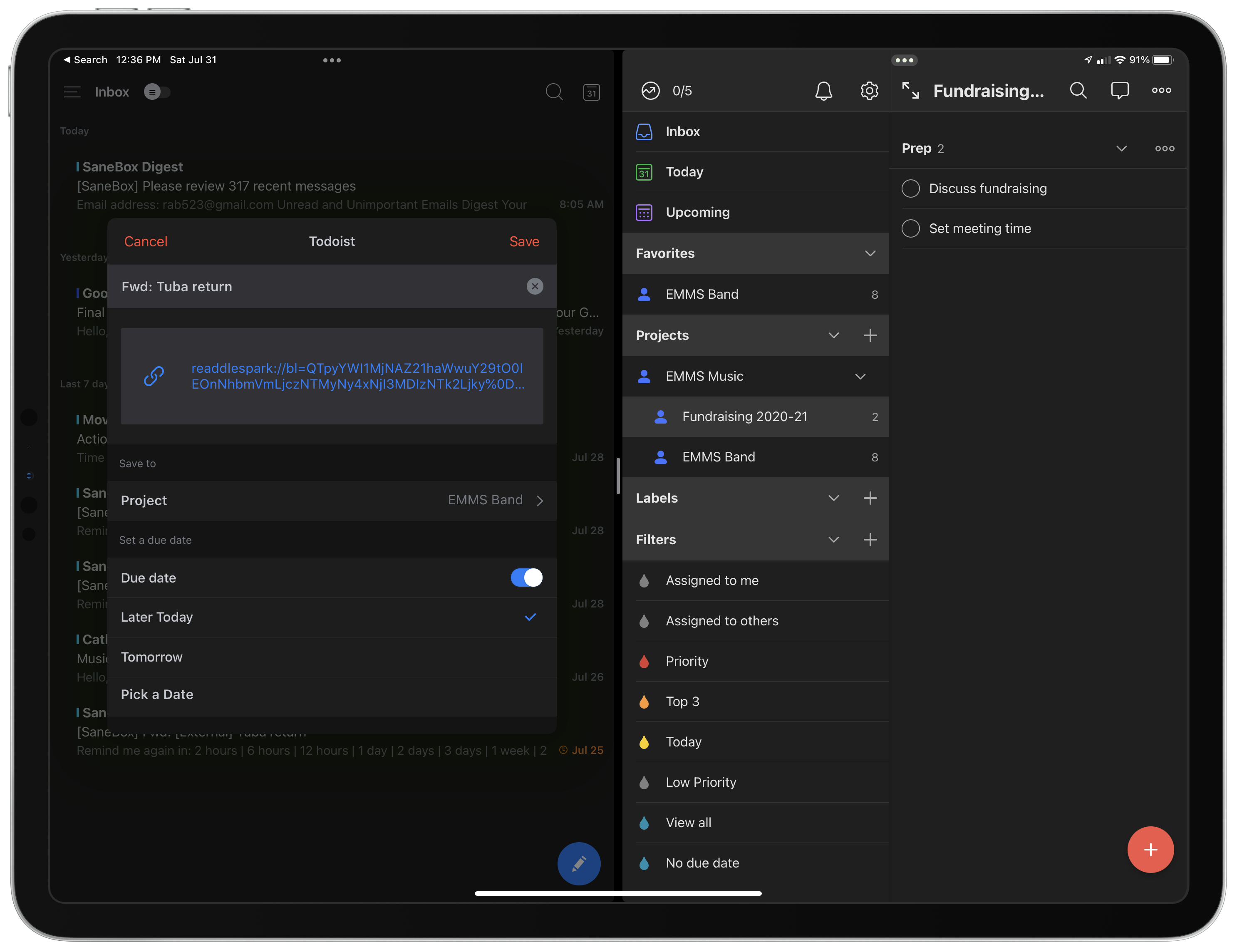
Todoist: Everyone needs a task manager! Todoist is cross-platform and has most of the features of all the major task apps. It even supports collaborative project lists you can share with your music team.
LEAVE: Software that gets in the way
Did you spend your waking life inside learning management software last year? Please accept my invitation to take a deep breath and discard anything that didn’t help your students learn last year.
TRANSFORM: New ways of creating engaging resources
I have shared some of the tools that make me productive. Now let’s explore the tools that help me develop resources. Many of the resources I had to make for virtual classes will enhance in-person teaching dramatically. Here are my favorite tools for making digital resources:
Neural Mix Pro: Takes an audio file and allows you to separate the vocals, drums, and other accompaniment and then export the resulting track. I used this to take vocals out of pop songs and then use them as the basis for scale play-along tracks last year. I also used it to separate vocals from pop songs for making remix projects in general music.
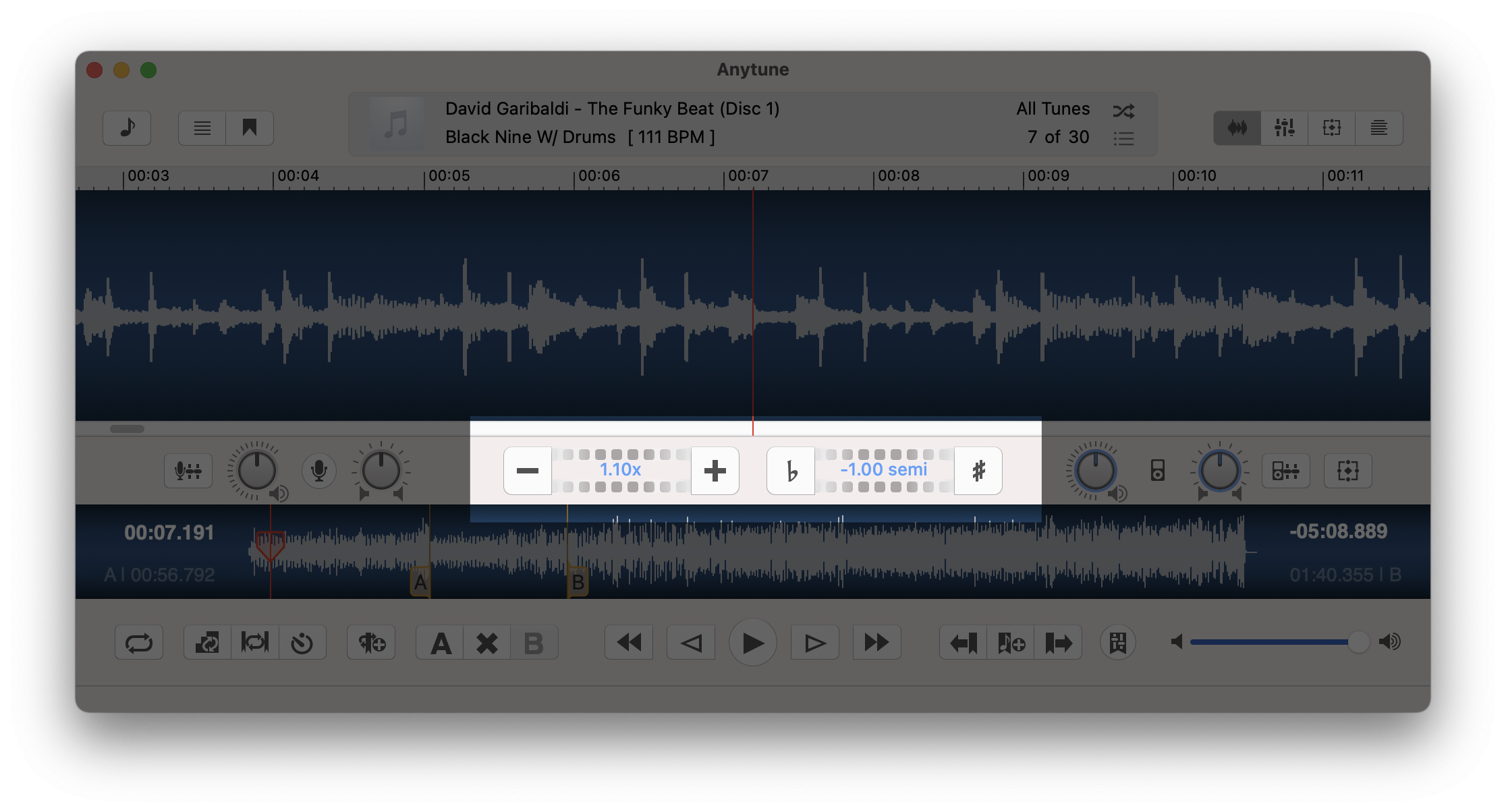
AnyTune: slowdown app that can take a song and change the speed and pitch independently. I use this to slow down recordings for students to practice along to (or to change it to a comfortable key). It is also capable of looping short sections of music for repetitive practice or improvisation.
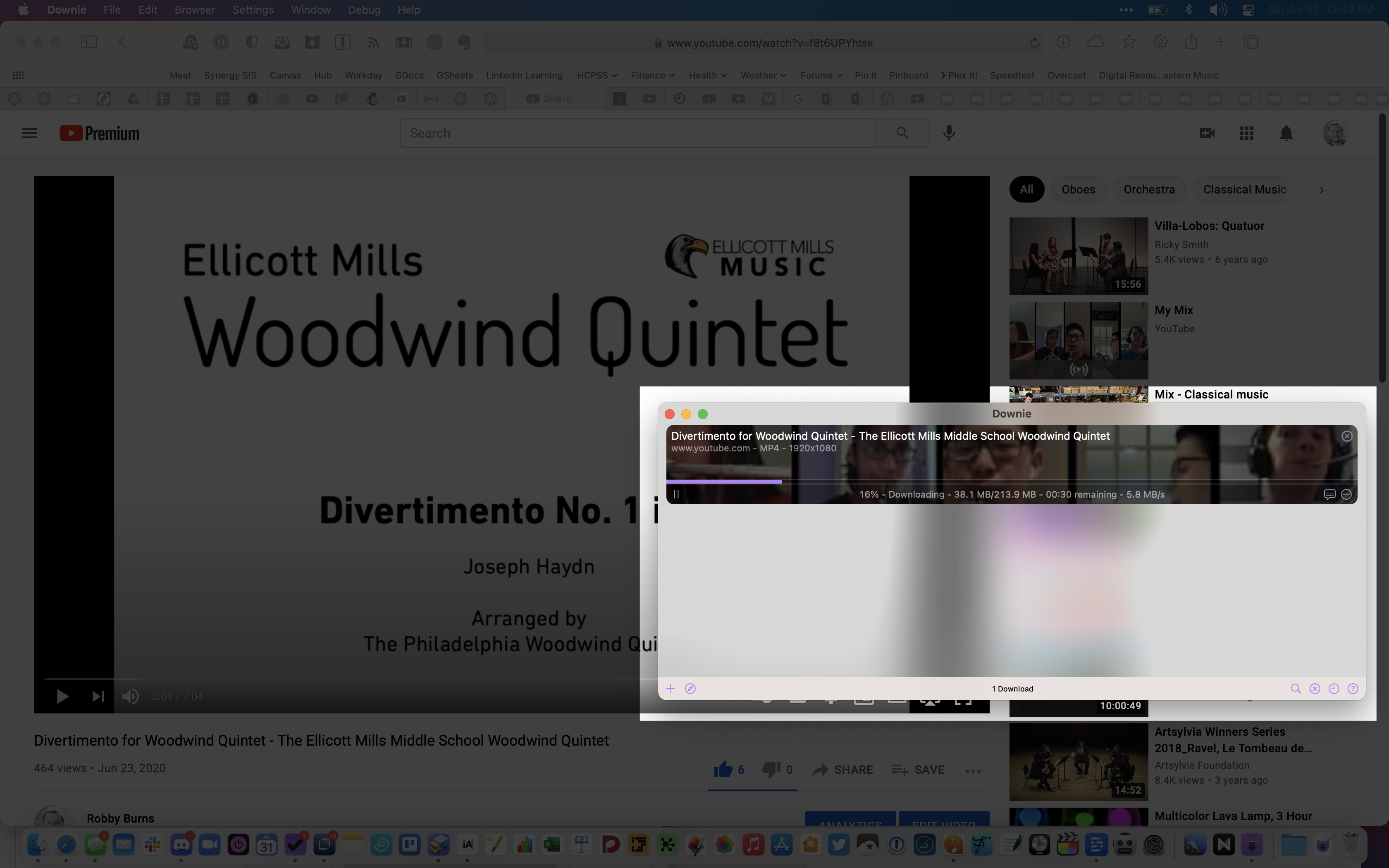
Downie, iCab Mobile, and YouTubeDL: These tools are all capable of downloading a video or audio file from a website to your hard drive. Note: There are numerous educational reasons to use this kind of tool that fall under fair use. Make sure you investigate relevant copyright law before publicly repurposing someone else’s work.
Logic and ScreenFlow: Any audio and video editor will do, but for me, these applications balance ease with power. They can manipulate audio and video in nearly any way, and I don’t feel like I need another degree to use them.
Communication
TAKE: Digital communication
I am also reflecting on every way that in-person collaboration can be made more efficient by going digital. I am mostly Zoom-ed out for the year, but when it comes to many of my music team’s interactions, sometimes something “could have been an email.” Digital communication helps us stay focused on our current tasks and address other’s concerns when we have the capacity, rather than being constantly interrupted.
LEAVE: Lengthy and verbose documents
The requirement of communicating through an LMS over the past year has made me realize that I can probably get away with shorter letters getting sent home in future years. Many families, especially students, responded well to concise and more frequent communication than the long-form alternative.
TRANSFORM: New models for non-musical logistics and collaboration
You can elevate your digital communication by trying the following strategies:
*Slack or Microsoft Teams (your district might already pay for the latter.) Both of these tools are similar. My music team uses Slack for all of our communication because it removes the cruft and formality of email while maintaining more structure than text messaging. Using this tool, my team has created a space where we can separate different topics by channel (examples include #concerts, #fieldtrips, #fundraisers,* and more). All conversation stays organized in a chat thread within these areas. Apps like Google Drive can be linked to your Slack so that you can manage the sharing settings of documents and even see them in-line, right from within Slack.
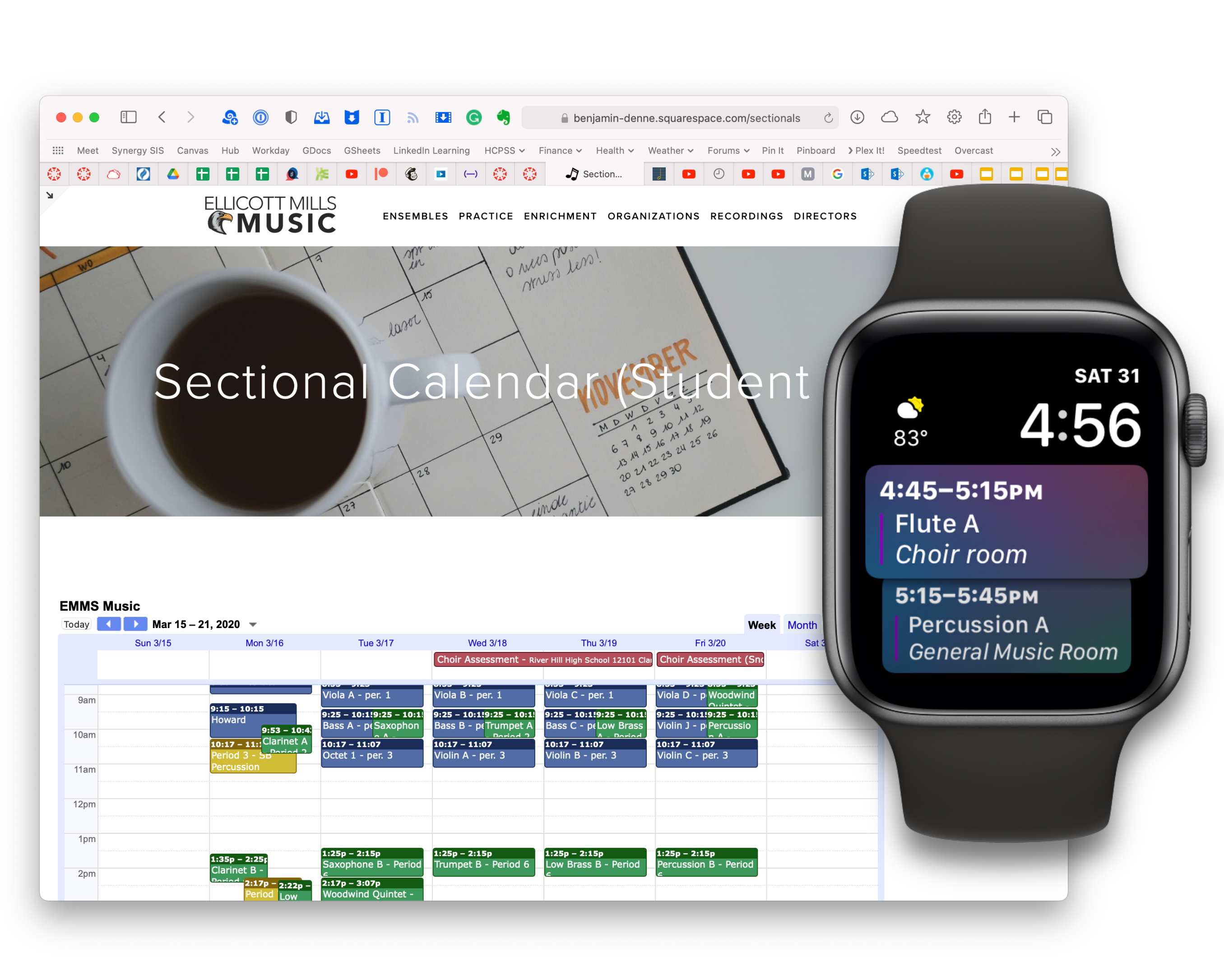
Google Calendar: By creating a Google account for our team and logging into it on all our devices, we have made a workflow where we can share our schedule for rehearsals, sectionals, concerts, and events, with one another, all from within the calendar app on our computers. The neat part is that because Google Calendars are web-first experiences, we can easily embed the HTML in a password-protected page of our music program website so that families always know where they need to be and when.
Hardware
TAKE: Microphones, interfaces, other pro audio hardware
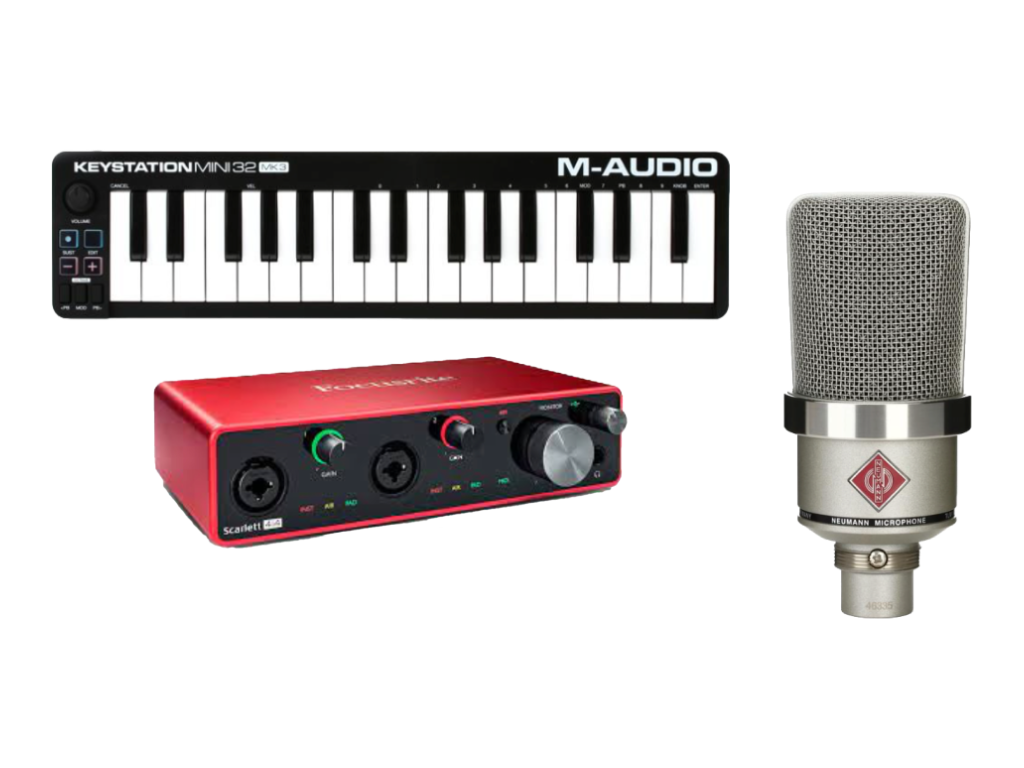
My team purchased some microphones, audio interfaces, and MIDI keyboards last year to enhance the quality of our virtual classrooms. Here are some of my favorite devices:
Audio Technica AT2020: This isn’t the cheapest microphone out there, but it’s reasonable, and you get so much more from it than an entry-level product.
Scarlet Solo: This is the most straightforward and reliable tool for getting third-party devices like microphones, keyboards, and speakers to route in and out of a computer.
Amazon Essentials MIDI Keyboard I use a full-sized keyboard as a MIDI controller in most cases, but for basic note entry in a notation editor, MIDI controllers are one place to cut costs. I have a set of these for my general music class, and they have lasted many years so far.
LEAVE: The need to be tethered to a computer
Need I say more? It is exhausting to need a computer, especially when it limits us. I can’t wait to talk directly to students, hear them play in real-time, and give them the quick, authentic feedback characteristic of vital music-making.
TRANSFORM: Proven models of teaching with the computer as an extension of the self
I am not ready to write off the computer, though. The hardware we bought last year can be repurposed. The MIDI controllers can trigger justly in-tune chords and intervals from the Tonal Energy Tuner app from the front of the band room. The microphone and interface can allow me to quickly record the band and play it back for them, in higher fidelity than the voice memos app on my phone.
Furthermore, apps I used to engage students with visual and auditory experiences can elevate what would otherwise be a traditional band rehearsal. Here are some examples of such software, which can be shared through a screen and speaker system:
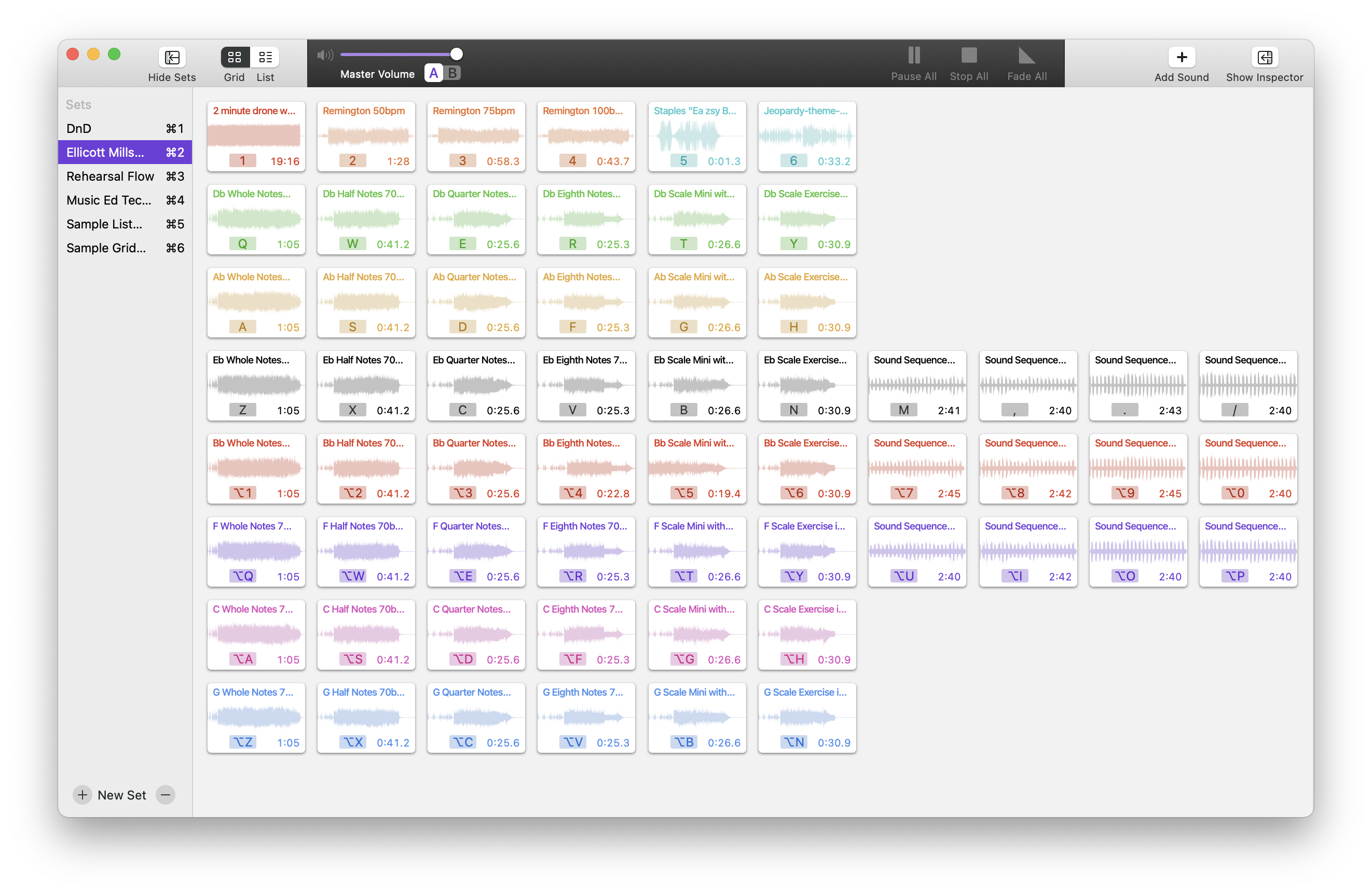
Farrago: Digital soundboard app that allows you to drag in mp3 files into a grid of squares where they can easily be triggered during rehearsal (or a school musical if you run one of those). It works for everything from play-along tracks (I have made some here, to fun sound effects. There is a sequential mode in which you can play them in a specified order automatically. I have used this feature to pre-record my entire warm-up for class. When I return to in-person instruction, I can use this warm-up approach to create two of “me” in the classroom. While students follow the recorded “me,” I have the freedom to work the room, connect with students, fix trombone posture, assist with music, and more.
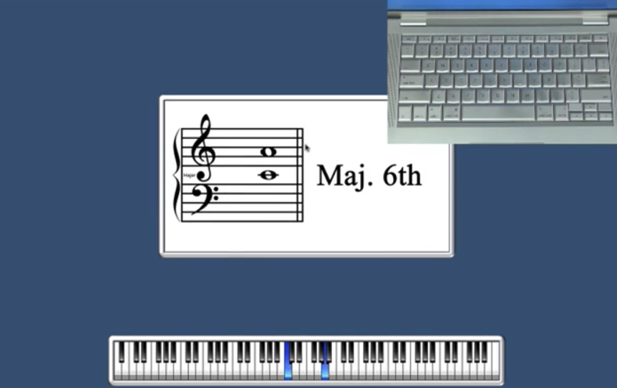
Classroom Maestro: This desktop application displays a piano on-screen that highlights the keys of the keyboard you are playing on your MIDI controller in blue while also showing the notes on a staff.
forScore, GoodNotes, Tonal Energy, and Shortcuts: These are the apps I usually have on the screen of my iPad when I am on the podium. forScore shows my music, GoodNotes shows my documents (and acts as a digital whiteboard), and Tonal Energy is used for tuning drones. By streaming these applications to my projector (directly or via a program like AirServer), I can now invite students into my world, displaying contextual information and enriching their musical experience.
Bonus tip! In an iPad software update coming this fall, you can automate the opening of all your materials using the Shortcuts app. See it in action below and download this example shortcut here.
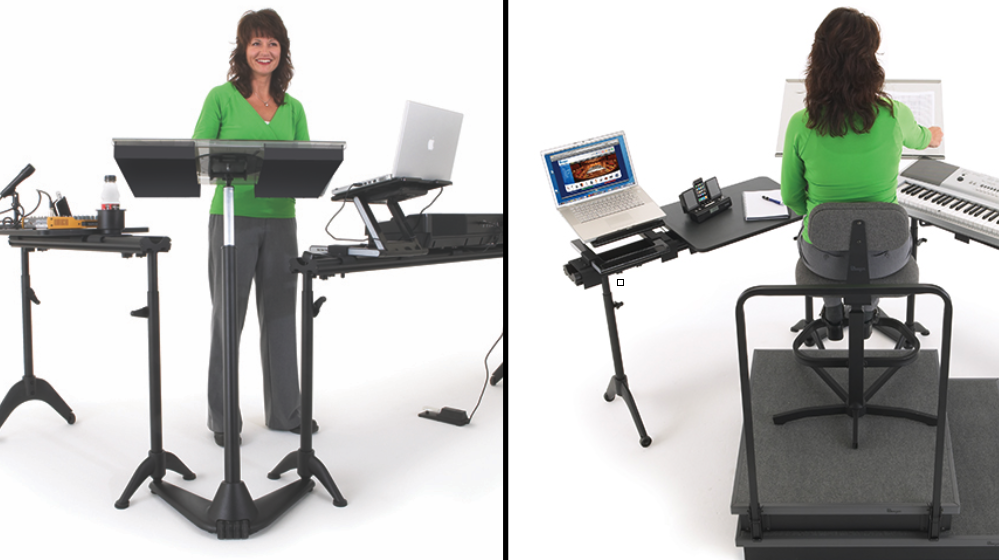
To wrangle all of the new tech I want to use during rehearsal, I am investigating the modular Flex® Conductor’s System from Wenger. It is an investment, but it will hopefully allow me to have keyboards and computers positioned more accessibly during rehearsal.
Assessment
TAKE: Assessment transparency
One thing I did enjoy about all assessments moving online was how they added transparency to all stakeholders. Every assignment, expectation, and instruction was in the same place, detailed in a web-accessible location for parents. Student progress was visible since things that were usually assessed informally needed to be online. I want to investigate how to keep some of this transparency moving forward.
LEAVE: Grades
I am doing some soul searching on the topic of grades and assessments this summer. If I thought grades bordered on meaningless before the pandemic, this problem has really been brought to light by a year of an ever increased achievement gap due to numerous inequities in our system.
Grades often inhibit the kind of curiosity and natural learning essential for students who are performing and creating.
TRANSFORM: New ways to foster student curiosity and reflection
I have been reading Ungrading (edited by Susan Blum), and it has caused me to ask some questions about where grades are really necessary. The book doesn’t challenge teachers to eliminate grades cold-turkey but instead offers lots of practical ways to reimagine the assessment process, making it feedback-centered and student-led.
Next year I am considering:
Student self-grading
Student-created rubrics
Grading process-oriented practices and putting skill-based objectives (like instrumental performance) in a separate part of my grade book that doesn’t touch the overall student average.
Eliminating processes that cause students and me to do less busy work.
Conclusion
As we prepare for the next year, I challenge you to ask yourself where the status quo wasn’t good enough and think about transforming your old teaching methods by adapting what we have learned this year.
Students and Teachers out there, how about Craft Pro for Free? 🤯 Our Back to School offer 🎒 just started and will be available until the end of September! 💥 As of the latest release: Customisation Options + Widget + Shortcuts Update = ❤️ https://t.co/Ps4p7S905W
Craft Download here is an app that has been getting a lot of attention in the Apple community lately for the way it makes the process of organizing and sharing information very elegant.
They are currently offering the pro version for FREE to teachers and students. Make sure you check out the tweet above for more details.
In their own words, Craft is a “tool for creating beautiful documents and notes and sharing your thoughts. Everything you create in Craft can be shared with one tap. Craft supports inline markdown, backlinks, code snippets, images, videos, attaching PDF files, and rich link previews.”
Craft is on iOS and macOS and is worth checking out.
It’s hard to pin down exactly how it might serve you because it is extremely versatile. If you like organizing and sharing your ideas, particularly if you are a lukewarm Google Docs user, this is worth a look.
One of the things I hate the most about the beginning of the school year is managing instrument rental. It just takes too long to log student instrument needs, cross reference them with my inventory, and type out all of my loan agreements. So I automated a part of that process.
Using the app Keyboard Maestro it is possible to automate almost anything under the sun using a simple graphic user interface. Imagine tons of actions available in macOS presented as draggable blocks that you can stack on top of one another and initiate with a keystroke, by time of day, or by an event happening on your machine. It’s like building with legos. And the sky is the limit.
Watch my automation in action. I have set it up to prompt me for some information about the instrument and student. Once entered, it makes a copy of the selected file in Finder, copies it, and names it after the student. Then Keyboard Maestro waits for my next click. After clicking in the upper-leftmost field, KM fills in the rest and saves the document.
If you want to break apart the logic of it, see the image below to get an idea which triggers and actions I have used to set up the automation. If you are a KB expert and know how I can make it more efficient, let me know! If you are new to the app and need help, let me know! Patreon supporters can get access to the actual macro, install it into your own copy of Keyboard Maestro, and edit it to your liking.
And just like that, Sibelius has their own iPad app. This comes after yesterday’s news that Dorico has released a desktop-class iPad app. If you want to learn more about that, click that link. I have some early first impressions, a video, and a podcast interview with Product Marketing Manager Daniel Spreadbury.
I don’t have much to say about Sibelius coming to iPad because I didn’t have any access to it before today, and because it hasn’t been my primary notation editor for years. But from 30 minutes of playing with it, it is pretty powerful and will certainly offer competition in this space, which is good! I want pro iPad apps to get better. The thing that is most impressive about it is how well adapted to the iPad it appears. It has multitasking, Files app integration, and some really intuitive touch/Apple Pencil touch gestures for note input that offer a new kind of ease and accuracy I wasn’t quite expecting.
You can watch a First Look video from Scoring Notes below and read their review here. You can download Sibelius for iPad here.
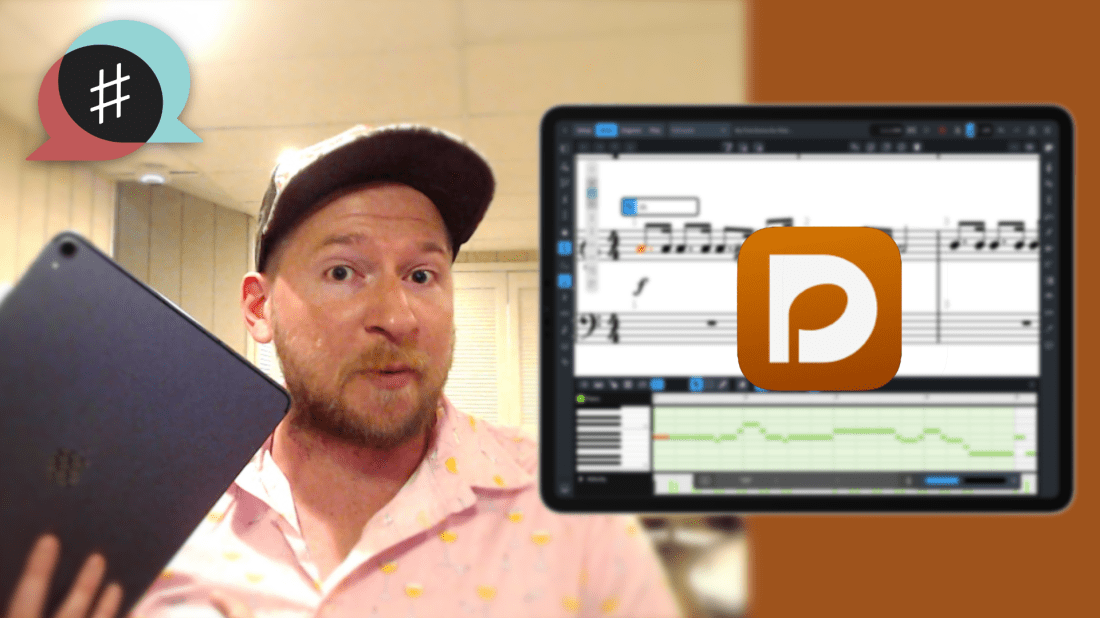
Dorico for iPad is out today! You can read their announcement here. It’s a desktop-class adaptation, which includes most of the features I need for my everyday work as a music teacher. I am beyond excited that a major professional scoring app has come to the iPad for two reasons:
I depend on iOS for getting much of my work done. There are still apps and workflows that require me to take out my Mac, and I am delighted whenever the release of a professional iPad app lessons these occurrences.
Our niche professional corner of the world is receiving legitimate, pro-featured, software for iPadOS, a market that is still light on “pro” software, even from Apple themselves (like, for real… where is Logic Pro on iPad?). While many “pro” iPad apps are companion experiences to bigger desktop versions, Dorico brings a whole lot of the power from its desktop app to its mobile version, proving that the iPad can be every bit as “pro” as its name suggests.
Dorico for iPad’s free tier is similar to their free desktop offering Dorico SE, and an in-app subscription adds features comparable to their Dorico Elements version. The iPad app has new features, many of which are optimizations for touch, including several new input methods (piano, fretboard, drum pads, and a new Key Editor). Dorico for iPad doesn’t do everything. Serious composers and power users might need the desktop for some things. For me, a middle school band director, it will fill most of my iOS composing needs.
There are some quirks due to Dorico not supporting features that make iPad apps feel like iPad apps: full Apple Pencil support, responsive touch gestures, file system integration, Magic Keyboard/trackpad support, and multitasking are examples of this. While there is room for improvement, it’s bold for the Dorico team to pack a desktop-class experience into the first version. I am thankful for their hard work and wish the Dorico team future success on this project.
Video
Watch Dorico for iPad in action.
Some Musings on Professional iPad Apps
When my long-time favorite iPad app (forScore) came to the Mac earlier this year, I wrote about it.
While forScore was one of the few remaining iPad apps I wanted on Mac, there are, similarly, plenty of Mac apps I would still love to see on iPad.
One could argue that with the latest iPad hardware (featuring M1 chips), there is no excuse for professional apps not to run on the platform. I agree! The iPad has more than enough processing power, all of the necessary input devices (if you have a keyboard and mouse), and even some things that the Mac doesn’t have (like touch support and the Apple Pencil).
The issue of why the iPad lacks pro apps is too broad to cover here, but it has much to do with how Apple has positioned iPadOS and the App Store model over the past 10 years. It is becoming easier than ever to make a cross-platform app, but this doesn’t change the fact that there are still some fundamentally dissimilar aspects of developing for iOS and macOS. The arguably bigger problem is that the App Store (even with fewer sandboxing limitations in recent years) is hostile towards the exact kind of developers who cater to niche professionals like composers and music teachers.
For example, companies who make digital audio workstations and notation editors have traditionally charged prices in the multiple hundreds of dollars, costs which the mobile market has decided is not acceptable. Such developers also offer things like crossgrade/upgrade/educational pricing, group licenses, and more. These are not feasible in the current-day App Store, and I think Apple is oblivious to keep calling the iPad Pro the iPad Pro while not providing more flexible App Store rules. This is not to mention that Apple hasn’t even brought their professional apps (Logic Pro, Final Cut Pro, and Xcode), to the iPad.
I am dependent on my iPad and prefer to work on it whenever possible. Its light form factor and simple operating system make me feel more nimble moving in and out of apps. Dorico has always been one of the reasons I have to take my Mac out of my bag when I am sitting on the couch wrapping up some school work late at night. Even though there are good score apps on iPad, the convenience of leaning back on the couch to get work done has been counterbalanced by needing to import and export XML files back and forth, just to get these apps to talk to Dorico on desktop.
It is within that context that I am pleased to say Dorico is available for iPad today. It’s the first of the major professional desktop scoring apps to be released on a mobile platform, and after just a few weeks of use, I can tell that it will become my primary notation editor on iOS.
I’m a Music Teacher
Because I am a music teacher, my opinions about scoring software are viewed through the lens of someone who does not depend on the entire feature set of Dorico, particularly engraving and playback. This means I usually need to get in and out of the program fast and that I am often performing tasks like writing scale exercises, reconstructing missing bass clarinet parts from my library, or adding percussion instruments to the score of a piece on our next concert. That said, I admire tools that empower me to work efficiently, and for notation, Dorico is that tool.
If you are looking for a professional composing perspective, and a more comprehensive feature overview, I recommend the Scoring Notes review of Dorico for iPad.
Dorico for iPad and Its Features
Dorico for iPad is an ambitious and stellar 1.0 that should make every developer of pro software take note and get to work.
The Dorico team has brought many of the core functions that make Dorico so powerful on Mac and Windows to the iPad version. All of the features I depend on are all there. It has keyboard input, powerful pop-overs, MIDI controller input, and all of the custom Notation and Layout Options that are available on desktop. It even has the same custom keyboard shortcut editor.
Dorico is available for free with a set of features very similar to their desktop offering Dorico SE. If you subscribe to the app through In-App Purchase, features are added which bring in line with the experience of using Dorico Elements.
Dorico for iPad has all of the modes you would expect: Setup, Write, Engrave, and Play. There is no Print mode and I don’t miss it. All of the export options I use regularly are conveniently accessed through a share button in the upper right corner of the application. Play mode supports third-party iOS plugins. This is certainly more limiting than desktop, because iOS doesn’t support traditional VSTs, but this is also not a feature I take advantage of anyway.
Dorico for iPad is so much Dorico that it is hard to write about it without reviewing the existing desktop versions, which is not something I have set out to do here. That said, it is worth noting some of the things that are added for touch, and some of the quirks that result from a desktop app being so faithfully reproduced on a touch-based tablet.
One of the things that makes Dorico on iPad feel so faithful to the desktop version is that computer keyboard input is nearly identical with a Magic Keyboard attached. Once I got acclimated to the small differences in the user interface, I comfortably began recalling all the same shortcuts and workflows I am used to.
Because this version is designed to be used without the keyboard attached, there are some added on-screen buttons for touch control. Extra toolbar buttons for things like delete, repeat, undo, redo, and moving the arrow keys, are all included.
A floating toolbar, which can be moved around on the screen, allows common note adjustments to be made by finger. This toolbar includes things like moving a selected note up/down, shifting a selection of notes right or left by a 16th note, etc…
Holding on the score with one finger and then dragging displays a rectangle on-screen that can select multiple elements of the score at once. And there are also some new methods of touch input:
An on-screen piano, which you can pan across and resize by dragging and pinching.
A fretboard for instruments like guitar.
Drum pads for percussion instruments (much more intuitive for writing drum set parts in my opinion.)
An integrated mixer which you can see right inside of Write mode.
A new Key Editor. I can best describe the Key Editor as a piano roll editing tool for the notes of your score. Users who are familiar with MIDI note editing in a digital audio workstation will love visualizing the notes of the staff as colorful rectangles. They can be dragged vertically to change pitch, horizontally to change the rhythm, and can be resized to adjust the duration. It is an intuitive way to work, particularly for touch.
Native Software
There will always be room for growth. What I want most from future iterations of Dorico on iPad can be best explained in the context of the forScore article I linked at the top of this post. forScore is a beloved app amongst musicians that is iPad-first but has recently been ported to the Mac through Apple’s Catalyst technology. My TL;DR in my forScore Mac review was basically to say that it’s amazing to have such an indispensable music app on Mac, even though it has some quirks relating to the fact that some iPad paradigms don’t translate to the Mac.
My Dorico first impressions are more or less the inverse of that statement. Dorico for iPad is desktop-class. What I’d like to see from it down the road is to become more iPad-native through taking advantage of common features on the platform. Dorico is written using Qt, a development platform that makes it easy to write one code base for Windows and Mac. This same development platform is what made it easier to bring Dorico to the iPad now, but for this same reason, I can understand that the team had their hands full prioritizing the features for the first version.
Now that the iPad Pro has excellent trackpad, keyboard, and mouse support, I don’t feel that different using it than I do my Mac in many instances. While Dorico’s “desktop-ness” is its greatest strength, its fluency makes the missing iPad-isms more apparent. Here are a few:
Dorico doesn’t have Apple Pencil support (with the exception of it imitating a touch in some circumstances).
Dorico does not work with the native File picker, which is to say that you can’t open a Dorico project from your Dropbox or iCloud Drive within the Files app, edit it, and then save it back to the original location. You must instead import it from within the Dorico app, which then makes a copy inside of the app. You can export it back to the original location you pulled it from, but don’t forget to delete the old copy! See an image below of OmniOutliner, a popular outlining app for iPad. When launched, it shows the same interface as the Files app. A document can be selected, edited, and saved back to the same location. I would love to see Dorico add this feature down the road.
Trackpad support isn’t native. Magic Keyboard users will note that two-finger swiping (which moves around the score in the Mac version) does nothing on iPad. Because the Magic Trackpad can simulate a finger, clicking and dragging with one finger will simulate the gesture of dragging the score around.
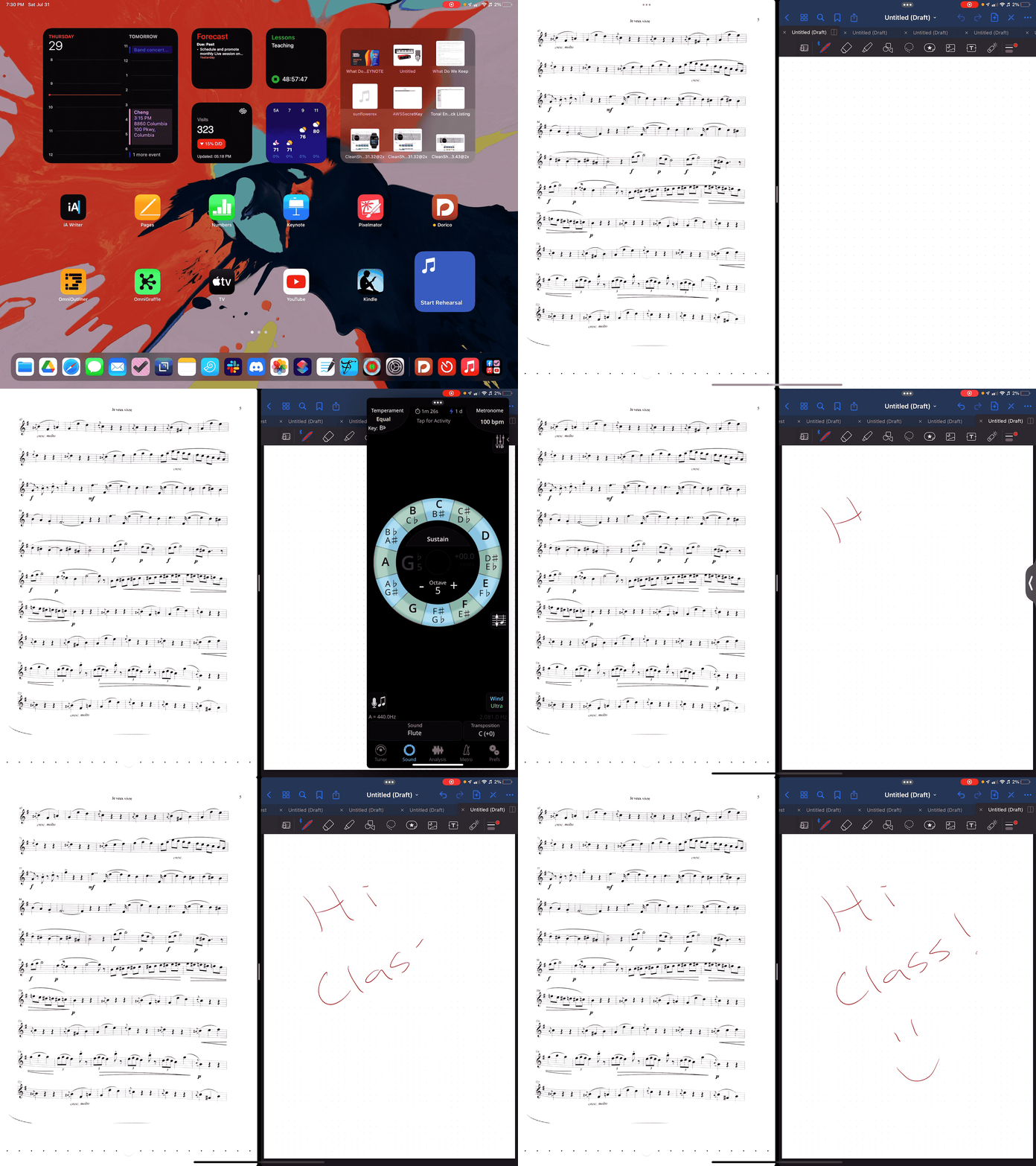
Dorico does not support multitasking features like Split View. This means that another app cannot share the screen at the same time unless it is in Slide Over mode which means it is a tiny, iPhone-sized, app that floats above Dorico and covers part of the information on the screen. One of my favorite workflows with notation software is to open it on half of the screen while referencing another score in forScore on the other half. The image below depicts forScore on screen at the same time as Dorico in Slide Over.
Elephants, Pencils, and Software Instruments
The obvious elephant in the room is StaffPad. StaffPad is not always included in conversations about major pro notation software (Sibelius, Finale, Dorico), but relative to the power of most iPad software in the App Store, it deserves to be a part of the conversation. I covered StaffPad here.
StaffPad feels very iPad-native and supports a premium design experience and numerous pro-features, like, for example, a store of top-of-the-line audio plugins within the app.
While the comparison to Dorico is fair, I also feel like StaffPad is aiming for a different experience. Sure, they will compete to some extent, but StaffPad is aiming at new innovative methods of input, and high-end audio output that is all intuitively integrated into the same package. For example, StaffPad features Apple Pencil gestures for note input, exclusively, and a forthcoming feature will listen to you play an instrument in the microphone and transcribe you in real-time. StaffPad’s third-party software instruments sound great and require little fuss to set up. It’s all a very iPad-first experience. But it’s an iPad-only experience (unless you are also using it on Windows).
The strength of Dorico on iPad is that you are getting much of the power of the desktop version, on iOS. This means that there are some quirks, but that you are ultimately less inhibited by what you can produce. Dorico’s Engrave mode allows you to get more customizable, better looking, scores and note input in the Write mode is just as easy to do with a computer keyboard or MIDI controller as it is on a desktop.
I do appreciate the novelty of writing scores with the Apple Pencil. It feels nice. In fairness to Dorico, I wanted to see if I am more efficient using this method. I took about 10 excerpts from my music teaching resource library (music I would use a notation editor for in real life) and timed myself recreating these excerpts into both StaffPad and Dorico.
Much like using the self-checkout lane of a grocery store, I “felt” faster in StaffPad, but I was about twice as fast at note entry using Dorico in every instance. I was also 100 percent sure that the note I input would be the note that appeared on the screen.
I appreciate that there is competition in this space, and I think that stylus input has a place in the future of mobile score software. But I have shifted most of my score work on iOS to Dorico, and will probably continue to do so in the future. It sure is great having another professional Mac app on iPad. Here’s to hoping that my other tools like Logic, Final Cut, and Descript are next in line.
Thanks Dorico team for an ambitious and excellent release. I am looking forward to years of updates.
forScore has long been my most essential iPad app, and one of the few apps I consider iPad-first. This is to say that it is an app that takes specific advantage of the iPad’s strengths (form factor, pencil support, paper-like display, direct touch input) and leverages them in a way that makes the iPad feel essential.
For the same reasons it is essential on iPad, it has seemed slightly less essential on the iPhone (small screen size is impractical) and Mac (similarly, the design is not easy for direct manipulation, annotation, portability, or sticking on a music stand).
Still, an app this useful screams to be used cross-platform! The more I moved my sheet music library from PDFs on my hard drive to forScore, the more I found I needed to be able to work with the same library structure on my other devices. An iPhone is small, but there are those moments when it is the only device on you and you want to reference something really quickly. In a moment that my iPad battery once failed, I did conduct a percussion ensemble rehearsal from forScore on the iPhone.
In the same way that the iPhone is sometimes useful for being always the one in your pocket, the Mac is also useful sometimes. For example, file management is way easier on a Mac. No matter how many Mac features the iPad adds (drag and drop, Files app, etc.), it is simply not as easy as the Mac. Yes, the iPad can technically do the same things as the Mac in this regard, but it’s slower and more cumbersome. Furthermore, most users know how to use the Finder on Mac but don’t know how to work with the Files app on iPad, even though it is mostly the same these days.
<div class="
      image-block-outer-wrapper
      layout-caption-below
      design-layout-inline
      combination-animation-none
      individual-animation-none
      individual-text-animation-none
    ">


    <figure class="
          sqs-block-image-figure
          intrinsic
        " style="max-width:800px">


      <div class="image-block-wrapper">
        <div class="sqs-image-shape-container-element


          has-aspect-ratio
        " style="position: relative;padding-bottom:75.125%;overflow: hidden">


            <img src="https://images.squarespace-cdn.com/content/v1/5595df9ce4b0ce9ff9ecd1a8/1625925617918-12I7KK37KZGE9QZ2BWRR/CleanShot+2021-07-10+at+09.28.40.gif" alt="It is actually possible to open forScore and the Files app side by side on the iPad. From there, you can drag and drop multiple files at once from one app to another." width="800" height="601" style="display:block;object-fit: cover;width: 100%;height: 100%;object-position: 50% 50%" loading="lazy">

        </div>
      </div>


      <figcaption class="image-caption-wrapper">
        <div class="image-caption"><p class="">It is actually possible to open forScore and the Files app side by side on the iPad. From there, you can drag and drop multiple files at once from one app to another.</p></div>
      </figcaption>


    </figure>


</div>
I’d like to note that a year of teaching (mostly) online has sent me “back to the Mac,” so to speak. The Mac’s efficiency in multitasking, as well as its ability to run streaming apps like OBS and Loopback, has positioned it as my primary work device. Streaming forScore to my iPad’s screen to my Mac using OBS and AirServer is great, but it’s fiddly, indirect, and kills my iPad battery. It has become so much more direct to have forScore running right on the Mac, in the same place my other work is already happening.
<div class="
      image-block-outer-wrapper
      layout-caption-below
      design-layout-inline
      combination-animation-none
      individual-animation-none
      individual-text-animation-none
    ">


    <figure class="
          sqs-block-image-figure
          intrinsic
        " style="max-width:1112px">


      <div class="image-block-wrapper">
        <div class="sqs-image-shape-container-element


          has-aspect-ratio
        " style="position: relative;padding-bottom:69.51438903808594%;overflow: hidden">


            <img src="https://images.squarespace-cdn.com/content/v1/5595df9ce4b0ce9ff9ecd1a8/1625925592095-E3Y17P6LRN6XUVQBSZWX/CleanShot+2021-07-10+at+09.30.44.png" alt="In video conferencing apps like Zoom, I can now share music on the screen with my students directly, thanks to forScore running on my Mac." width="1112" height="773" style="display:block;object-fit: cover;width: 100%;height: 100%;object-position: 50% 50%" loading="lazy">

        </div>
      </div>


      <figcaption class="image-caption-wrapper">
        <div class="image-caption"><p class="">In video conferencing apps like Zoom, I can now share music on the screen with my students directly, thanks to forScore running on my Mac.</p></div>
      </figcaption>


    </figure>


</div>
The wait is over. Actually, it has been over since the fall. With the launch of macOS 11 Big Sur, forScore has released a universal version of their app on the Mac App Store. This means that it will be a free download for those who have purchased the app on iPad.
Note: I wrote most of this review fairly soon after release. Its scope is therefore more like what I would call “First Impressions.” I have been using it all school year long by the time I am actually posting this and think it is now more accurate to call it a review even though I will not be covering every detail comprehensively in the words below.
The goal of this review is to cover what’s unique about the Mac experience. If you want to learn more about forScore’s features, check out this excellent review by David MacDonald
For more on this subject (and speaking of David MacDonald), listen to my podcast review of forScore for Mac, where he was the guest.
Having forScore on the Mac is a huge deal for me. I have been using it aggressively since the fall. It is on a shared screen during every band class and private percussion lesson I teach. Using it right on the Mac is just as easy as I expected.
All of the buttons, knobs, bells, whistles and user interface elements are exactly where you would expect them to be because it looks and feels like the iPad app. I will get into the implications of that in a moment.
Adding music to my library is now a breeze. Until this point, I have been storing all of my scores in a folder in iCloud Drive and then creating duplicate copies in the iPad version of my forScore library. This means that to share music on my Mac’s screen (without doing the AirPlay method above), I have to open the files in PDF Expert. They don’t have any of my indexes, metadata, or attached recordings. I cannot annotate them as I can in forScore, or use music stamps, and I cannot see them in the context of my organized setlist. It is in some ways like maintaining two separate libraries of the same stuff.
To make matters worse, iCloud Drive periodically decides to put some of my scores back in the cloud when I am low on space. When this happens, and I try to open a score from the Spotlight, even a score I used the day before, I will have to wait an extra-long time for my Mac to download the file before actually opening it.
I am happy to report that forScore on the Mac resolves these frustrations. Not only is it lightning-fast for me to get all of the scores that were not in my forScore database inside of it, but scores can also now sync across devices over iCloud. Using keyboard shortcuts like Command+Clicking, Command+Tabbing, and the precision of the keyboard and mouse, allowed me to easily drag and drop most of my remaining digital sheet music library straight into forScore from the Finder. I never pushed forScore too hard in this regard, but at one point, I dragged about 40 scores into forScore from the Finder at once and it handled them with a breeze. This is something the iPad would occasionally crash while trying to do.
<div class="
      image-block-outer-wrapper
      layout-caption-below
      design-layout-inline
      combination-animation-none
      individual-animation-none
      individual-text-animation-none
    ">


    <figure class="
          sqs-block-image-figure
          intrinsic
        " style="max-width:800px">


      <div class="image-block-wrapper">
        <div class="sqs-image-shape-container-element


          has-aspect-ratio
        " style="position: relative;padding-bottom:62.5%;overflow: hidden">


            <img src="https://images.squarespace-cdn.com/content/v1/5595df9ce4b0ce9ff9ecd1a8/1625925693795-EPHCPH8HKUPPQ5MTUC4M/CleanShot+2021-07-10+at+09.23.47.gif" alt="The file import process I showed on the iPad above is far faster and more precise on macOS." width="800" height="500" style="display:block;object-fit: cover;width: 100%;height: 100%;object-position: 50% 50%" loading="lazy">

        </div>
      </div>


      <figcaption class="image-caption-wrapper">
        <div class="image-caption"><p class="">The file import process I showed on the iPad above is far faster and more precise on macOS.</p></div>
      </figcaption>


    </figure>


</div>
Because of this ease, finding duplicated, and deleting them was also easy. So was adding metadata. The Mac is now my preferred tool for doing this kind of logistic work in bulk.
Catalyst
forScore uses Apple’s Catalyst technology which means that Mac apps can share code with iPad apps. Apple introduced this at WWDC in 2019 and in the year that followed, relatively few apps made this transition. A notably good app using this technology is GoodNotes 5. They ditched their native Mac app in version 5 and decided to bring the iPad version over. GoodNotes is a good comparison to forScore, because its strength is, similarly, that it is a touch-first app that feels best when conceptualized as a digital “piece of paper.”
Catalyst apps can be automatically provided to the Mac by the developer with one press of a button, but they won’t be good experiences. Developers can do more work to have the app feel more like it belongs on the Mac, using things like the Touch Bar, custom Tool Bar elements, keyboard shortcuts, etc. The results have been lackluster. Still, having a Mac version of GoodNotes is better than not having one. And because it is an app I usually use on iPad, the need for the Mac version was more for reference.
<div class="
      image-block-outer-wrapper
      layout-caption-below
      design-layout-inline
      combination-animation-none
      individual-animation-none
      individual-text-animation-none
    ">


    <figure class="
          sqs-block-image-figure
          intrinsic
        " style="max-width:2466px">


      <div class="image-block-wrapper">
        <div class="sqs-image-shape-container-element


          has-aspect-ratio
        " style="position: relative;padding-bottom:70.39740753173828%;overflow: hidden">


            <img src="https://images.squarespace-cdn.com/content/v1/5595df9ce4b0ce9ff9ecd1a8/1625925921736-L6THJ0HVCWSCJ3NVTIU4/CleanShot+2021-07-10+at+09.33.20%402x.png" alt="GoodNotes 5 on the Mac. It looks good. But I am constantly forgetting whether to double or single tap on things because it behaves like an iPad app, but I have the conventions of a Mac hardwired into my brain when I am sitting in front of one." width="2466" height="1736" style="display:block;object-fit: cover;width: 100%;height: 100%;object-position: 50% 50%" loading="lazy">

        </div>
      </div>


      <figcaption class="image-caption-wrapper">
        <div class="image-caption"><p class="">GoodNotes 5 on the Mac. It looks good. But I am constantly forgetting whether to double or single tap on things because it behaves like an iPad app, but I have the conventions of a Mac hardwired into my brain when I am sitting in front of one.</p></div>
      </figcaption>


    </figure>


</div>


<div class="
      image-block-outer-wrapper
      layout-caption-below
      design-layout-inline
      combination-animation-none
      individual-animation-none
      individual-text-animation-none
    ">


    <figure class="
          sqs-block-image-figure
          intrinsic
        " style="max-width:2466px">


      <div class="image-block-wrapper">
        <div class="sqs-image-shape-container-element


          has-aspect-ratio
        " style="position: relative;padding-bottom:70.39740753173828%;overflow: hidden">


            <img src="https://images.squarespace-cdn.com/content/v1/5595df9ce4b0ce9ff9ecd1a8/1625925943296-PZECRR7DN8VCHN5QJDL6/CleanShot+2021-07-10+at+09.33.07%402x.png" alt="This is an even weirder example of an iPad toolbar on Mac, but it brings GoodNotes to my Mac, and for that I am grateful." width="2466" height="1736" style="display:block;object-fit: cover;width: 100%;height: 100%;object-position: 50% 50%" loading="lazy">

        </div>
      </div>


      <figcaption class="image-caption-wrapper">
        <div class="image-caption"><p class="">This is an even weirder example of an iPad toolbar on Mac, but it brings GoodNotes to my Mac, and for that I am grateful.</p></div>
      </figcaption>


    </figure>


</div>
At WWDC in 2020, Apple announced that more developer tools would be coming to Catalyst, so that it is easier to bring even more of the things that make Mac apps feel like Mac apps to your iPad version. They also announced that new Macs would be coming out (they shipped on November 17th) with new processors built by Apple. These new machines would be able to run native iOS apps without developers doing anything at all.
Steven Troughton Smith highlights these three methods on Twitter.
I imagine forScore went with the last of those three options for the Mac. Even though it feels like a mostly native experience, some things get weird.
With everything in macOS 11, it’s getting harder to define what Catalyst is. There are 3 forms:
• Unmodified iOS apps (Apple Silicon-only) • Traditional Catalyst apps (more Mac like, but blurry scaling) • Optimized for Mac/Mac Idiom Catalyst apps (pixel perfect, Mac controls)
There are things about forScore on Mac that “look” like the iPad and things that “behave” like the iPad. The things that look like iPad are more forgivable.
For example, the toolbar of an iPad app looks distinct from that of the Mac. Apple is attempting to blur this distinction by redesigning their stock apps to have buttons that are made of thin-lined graphics, rather than appearing as press-able buttons.
<div class="
      image-block-outer-wrapper
      layout-caption-below
      design-layout-inline
      combination-animation-none
      individual-animation-none
      individual-text-animation-none
    ">


    <figure class="
          sqs-block-image-figure
          intrinsic
        " style="max-width:660px">


      <div class="image-block-wrapper">
        <div class="sqs-image-shape-container-element


          has-aspect-ratio
        " style="position: relative;padding-bottom:6.363636016845703%;overflow: hidden">


            <img src="https://images.squarespace-cdn.com/content/v1/5595df9ce4b0ce9ff9ecd1a8/1625927574019-GM7BSBYVSPMU4JVA8HM1/CleanShot+2021-07-10+at+10.26.59.png" alt="The old macOS toolbar used to look like this." width="660" height="42" style="display:block;object-fit: cover;width: 100%;height: 100%;object-position: 50% 50%" loading="lazy">

        </div>
      </div>


      <figcaption class="image-caption-wrapper">
        <div class="image-caption"><p class="">The old macOS toolbar used to look like this.</p></div>
      </figcaption>


    </figure>


</div>


<div class="
      image-block-outer-wrapper
      layout-caption-below
      design-layout-inline
      combination-animation-none
      individual-animation-none
      individual-text-animation-none
    ">


    <figure class="
          sqs-block-image-figure
          intrinsic
        " style="max-width:2184px">


      <div class="image-block-wrapper">
        <div class="sqs-image-shape-container-element


          has-aspect-ratio
        " style="position: relative;padding-bottom:5.6776556968688965%;overflow: hidden">


            <img src="https://images.squarespace-cdn.com/content/v1/5595df9ce4b0ce9ff9ecd1a8/1625926010644-DXF4VPMDVEBHUUU8GOPP/CleanShot+2021-07-10+at+09.34.25%402x.png" alt="By contrast, iOS apps that are brought to the Mac with Catalyst have a toolbar that looks like this." width="2184" height="124" style="display:block;object-fit: cover;width: 100%;height: 100%;object-position: 50% 50%" loading="lazy">

        </div>
      </div>


      <figcaption class="image-caption-wrapper">
        <div class="image-caption"><p class="">By contrast, iOS apps that are brought to the Mac with Catalyst have a toolbar that looks like this.</p></div>
      </figcaption>


    </figure>


</div>


<div class="
      image-block-outer-wrapper
      layout-caption-below
      design-layout-inline
      combination-animation-none
      individual-animation-none
      individual-text-animation-none
    ">


    <figure class="
          sqs-block-image-figure
          intrinsic
        " style="max-width:2318px">


      <div class="image-block-wrapper">
        <div class="sqs-image-shape-container-element


          has-aspect-ratio
        " style="position: relative;padding-bottom:5.780845642089844%;overflow: hidden">


            <img src="https://images.squarespace-cdn.com/content/v1/5595df9ce4b0ce9ff9ecd1a8/1625926023520-5OPPPFE0T935YJ3UJVHZ/CleanShot+2021-07-10+at+09.35.00%402x.png" alt="The new macOS toolbar seeks to blur this distinction by bringing its own toolbar design closer to that of iPad apps." width="2318" height="134" style="display:block;object-fit: cover;width: 100%;height: 100%;object-position: 50% 50%" loading="lazy">

        </div>
      </div>


      <figcaption class="image-caption-wrapper">
        <div class="image-caption"><p class="">The new macOS toolbar seeks to blur this distinction by bringing its own toolbar design closer to that of iPad apps.</p></div>
      </figcaption>


    </figure>


</div>
iOS apps also have different pop-over style elements that feature a Cancel button in the upper left and a Done button in the upper right. These don’t feel Mac-like but they get the job done. You can, for example, still press Escape to dismiss them like you can on a Mac, though the difference in user interface might suggest otherwise.
<div class="
      image-block-outer-wrapper
      layout-caption-below
      design-layout-inline
      combination-animation-none
      individual-animation-none
      individual-text-animation-none
    ">


    <figure class="
          sqs-block-image-figure
          intrinsic
        " style="max-width:1582px">


      <div class="image-block-wrapper">
        <div class="sqs-image-shape-container-element


          has-aspect-ratio
        " style="position: relative;padding-bottom:128.06573486328125%;overflow: hidden">


            <img src="https://images.squarespace-cdn.com/content/v1/5595df9ce4b0ce9ff9ecd1a8/1625926353940-01RZ0O2TIHUM2W052HPV/CleanShot+2021-07-10+at+10.11.24%402x.png" alt="Alerts and settings screens trip me up with Catalyst apps because they really make me feel like I am using an iPad." width="1582" height="2026" style="display:block;object-fit: cover;width: 100%;height: 100%;object-position: 50% 50%" loading="lazy">

        </div>
      </div>


      <figcaption class="image-caption-wrapper">
        <div class="image-caption"><p class="">Alerts and settings screens trip me up with Catalyst apps because they <em>really</em> make me feel like I am using an iPad.</p></div>
      </figcaption>


    </figure>


</div>


<div class="
      image-block-outer-wrapper
      layout-caption-below
      design-layout-inline
      combination-animation-none
      individual-animation-none
      individual-text-animation-none
    ">


    <figure class="
          sqs-block-image-figure
          intrinsic
        " style="max-width:1674px">


      <div class="image-block-wrapper">
        <div class="sqs-image-shape-container-element


          has-aspect-ratio
        " style="position: relative;padding-bottom:71.68458557128906%;overflow: hidden">


            <img src="https://images.squarespace-cdn.com/content/v1/5595df9ce4b0ce9ff9ecd1a8/1625926372271-7XBJJL36WU5ENAIJ9M5M/CleanShot+2021-07-10+at+10.11.46%402x.png" alt="By contrast, here is the user interface of the OmniFocus settings screen, which follows native Mac app conventions." width="1674" height="1200" style="display:block;object-fit: cover;width: 100%;height: 100%;object-position: 50% 50%" loading="lazy">

        </div>
      </div>


      <figcaption class="image-caption-wrapper">
        <div class="image-caption"><p class="">By contrast, here is the user interface of the OmniFocus settings screen, which follows native Mac app conventions.</p></div>
      </figcaption>


    </figure>


</div>
Here are some other details and quirks that highlight the varying degrees of success that forScore has at being Mac-like…
Window resizing
Windows can be resized on Mac. This is implemented pretty well in forScore. When the window is dragged to certain dimensions, the score will automatically decide if it is better to fit one or two pages of the score on the screen. As with an iPad, you can click the book-looking button to the left of the file’s title to force it to keep two pages on screen, regardless of window size. Tools in the toolbar also automatically disappear at smaller window sizes and reappear at larger ones.
<div class="
      image-block-outer-wrapper
      layout-caption-below
      design-layout-inline
      combination-animation-none
      individual-animation-none
      individual-text-animation-none
    ">


    <figure class="
          sqs-block-image-figure
          intrinsic
        " style="max-width:800px">


      <div class="image-block-wrapper">
        <div class="sqs-image-shape-container-element


          has-aspect-ratio
        " style="position: relative;padding-bottom:72.125%;overflow: hidden">


            <img src="https://images.squarespace-cdn.com/content/v1/5595df9ce4b0ce9ff9ecd1a8/1625926073403-R9CJPA55LPPTLYG3XY50/CleanShot+2021-07-10+at+09.36.12.gif" alt="forScore can do things on Mac it can’t do on iPad, like window resizing!" width="800" height="577" style="display:block;object-fit: cover;width: 100%;height: 100%;object-position: 50% 50%" loading="lazy">

        </div>
      </div>


      <figcaption class="image-caption-wrapper">
        <div class="image-caption"><p class="">forScore can do things on Mac it can’t do on iPad, like window resizing!</p></div>
      </figcaption>


    </figure>


</div>
Menu bar
The Mac has the menu bar which exposes (in well-made software) all of the available actions in the app. This helps with discoverability and customization. Users can always find what they want from the menu bar and can set menu bar items as keyboard shortcuts in the System Preferences app. It is nice to see many of forScore’s options in the menu bar, but I am not certain that all of them are there. Fortunately, forScore for Mac has an area in settings that allows you to customize keyboard shortcuts for many of the app’s features.
<div class="
      image-block-outer-wrapper
      layout-caption-below
      design-layout-inline
      combination-animation-none
      individual-animation-none
      individual-text-animation-none
    ">


    <figure class="
          sqs-block-image-figure
          intrinsic
        " style="max-width:983px">


      <div class="image-block-wrapper">
        <div class="sqs-image-shape-container-element


          has-aspect-ratio
        " style="position: relative;padding-bottom:82.80773162841797%;overflow: hidden">


            <img src="https://images.squarespace-cdn.com/content/v1/5595df9ce4b0ce9ff9ecd1a8/1625925996474-FBX5YWUGJMS2ONEK8SDA/CleanShot+2021-07-09+at+09.39.48.png" alt="You can set up custom keyboard shortcuts in forScore." width="983" height="814" style="display:block;object-fit: cover;width: 100%;height: 100%;object-position: 50% 50%" loading="lazy">

        </div>
      </div>


      <figcaption class="image-caption-wrapper">
        <div class="image-caption"><p class="">You can set up custom keyboard shortcuts in forScore.</p></div>
      </figcaption>


    </figure>


</div>
Page navigation
It’s really weird. Simply put, page navigation conventions that work on iPad do not always translate to the Mac. For example, touching and dragging the screen to turn pages is natural when you use your hand to turn the pages, but less so with a keyboard and mouse. Common Mac conventions like two-finger scrolling to swipe pages are implemented in forScore. But other things are weird. Two-finger scrolling feels more natural in other document-based apps like, for example, Preview. In forScore, you can pinch to zoom, but pages that are zoomed in larger than the window size take extra page-turning gestures to navigate. This if because forScore’s default behavior when you swipe is to show you whatever of the page is not on the display. This makes sense because in a performance you might want to zoom in closer to the music. When doing this, it makes sense that a one-touch gesture reveals the next part of the music (regardless of what page it is on), but in practice, this is not Mac-like. Any other app that deals with PDFs would show me the next page when I do the page turn gesture. This quirk is particularly weird if your score is just a few pixels taller than the window size you have set. Turning the page takes two swipes instead of one. The first swipe awkwardly jolts the screen down just enough to see the few missing pixels at the bottom of the screen, and the next swipe actually turns the page.
<div class="
      image-block-outer-wrapper
      layout-caption-below
      design-layout-inline
      combination-animation-none
      individual-animation-none
      individual-text-animation-none
    ">


    <figure class="
          sqs-block-image-figure
          intrinsic
        " style="max-width:625px">


      <div class="image-block-wrapper">
        <div class="sqs-image-shape-container-element


          has-aspect-ratio
        " style="position: relative;padding-bottom:128%;overflow: hidden">


            <img src="https://images.squarespace-cdn.com/content/v1/5595df9ce4b0ce9ff9ecd1a8/1625926106078-YBOGTZI6YTS3LX4EQURA/CleanShot+2021-07-10+at+09.40.48.gif" alt="When my window is just too short, I have to turn the page twice, to turn it once. These kinds of quirks aren’t terrible, but when you encounter them, it’s easy to perceive the app as broken or untrustworthy." width="625" height="800" style="display:block;object-fit: cover;width: 100%;height: 100%;object-position: 50% 50%" loading="lazy">

        </div>
      </div>


      <figcaption class="image-caption-wrapper">
        <div class="image-caption"><p class="">When my window is just too short, I have to turn the page twice, to turn it once. These kinds of quirks aren’t terrible, but when you encounter them, it’s easy to perceive the app as broken or untrustworthy.</p></div>
      </figcaption>


    </figure>


</div>
Zooming in and out
The above-mentioned quirk is even weirder when you have zoomed in a lot. I do this often to focus my students on a particular excerpt of music. When scrolled in, there is (to my knowledge) no way to keep scrolling from the trackpad. You have to zoom out, turn the page, and then zoom in again. Contrast this with Preview, a native Mac app, which will just let me scroll freely through the document, no matter how far I have zoomed in.
Spotlight!
I am pleased to say that searching for score files in Spotlight (Command+Spacebar) results in all my scores showing up, even chapter titles in an index of a larger score.
Mac apps tend to have sidebars that reveal list views and top-levels of organization hierarchy in an app. These can often be toggled on and off though I usually leave them on so I can get to things more quickly. forScore on the Mac supports the option to keep the sidebar permanently visible, so you can always see your library alongside whatever score is selected. Cool.
<div class="
      image-block-outer-wrapper
      layout-caption-below
      design-layout-inline
      combination-animation-none
      individual-animation-none
      individual-text-animation-none
    ">


    <figure class="
          sqs-block-image-figure
          intrinsic
        " style="max-width:3360px">


      <div class="image-block-wrapper">
        <div class="sqs-image-shape-container-element


          has-aspect-ratio
        " style="position: relative;padding-bottom:62.5%;overflow: hidden">


            <img src="https://images.squarespace-cdn.com/content/v1/5595df9ce4b0ce9ff9ecd1a8/1625928115026-OIGE0M403046LJKCTLEJ/CleanShot+2021-07-10+at+09.19.11%402x.png" alt="I like that the Mac version of forScore supports a permanently-visible left sidebar. I wouldn’t mind this feature on my 12.9 inch iPad Pro." width="3360" height="2100" style="display:block;object-fit: cover;width: 100%;height: 100%;object-position: 50% 50%" loading="lazy">

        </div>
      </div>


      <figcaption class="image-caption-wrapper">
        <div class="image-caption"><p class="">I like that the Mac version of forScore supports a permanently-visible left sidebar. I wouldn’t mind this feature on my 12.9 inch iPad Pro.</p></div>
      </figcaption>


    </figure>


</div>
Conclusion
There are of course more Mac-like things to celebrate and more iPad-like things to question, but the bottom line is this: forScore is an app loved by musicians all over, and it is completely stellar that the developers dedicated time to bringing this application over. It is unknown if it would ever have happened without Apple’s Catalyst technology, but because of it, we get to have a pretty ok Mac app, where we otherwise would not. And having a pretty ok Mac version of an indispensable iPad app is… actually great! So thank you forScore team!
There are certainly more Mac apps that I would love to see on iOS than there are iOS apps I would like to see on the Mac, but the list is getting smaller.
Earlier in the summer I started a Patreon to gather some support for this blog and podcast. One of the perks that all levels get is to join the Music Ed Tech Talk Discord server where you can talk all about your favorite music, tech, and teaching practices.
So far I have a few supporters and there has been some pretty lively discussion, particularly about the subject of grading.
Some members of the Discord decided to read Ungrading together. Ungrading is a collection of short writings by teachers who have, in varying ways, decided to eliminate some (or all) of the grading from their teaching. It sounds extreme. But so far I am finding it more practical than expected. There is a lot you can take or leave from it.
We are running a public summer book club to talk about it. The book club is going to meet over the next month or so on Wednesday’s at 8:30 pm EST. We tried it on Twitter Spaces last week with some amount of success and are going to try it on Clubhouse this coming Wednesday to see if it is a better and more engaging experience.
You do not need to be a member of my Discord to join the conversation or listen in. However, Clubhouse does require an invite. If you need one, let me know.
Here is a link to the book. Below is a link to the Clubhouse discussion.
Round 1 of my summer book club had some weirdnesses on Twitter Spaces so we are experimenting with Clubhouse next week.
DM me for invites.
“Summer Book Club: UNgrading” with Music Ed Tech Talk. Wednesday, Jul 14 at 8:30 PM EDT on @clubhouse. Join us! https://t.co/F0ZQDxykx3
I aspire to write more about my smart home setup here but doing so requires a style of writing that doesn’t always come easily for me. So I decided to podcast about it. Scroll below to hear my recent conversation with David MacDonald about how I set up my smart speakers. Click here to learn about my favorite smart home devices.
Episode Description:
Robby and David (music composition, theory, and technology teacher at the Wichita State University) compare smart speakers, their assistants, and their smart home ecosystems. This episode covers the HomePod, Google Nest, Amazon Echo, Siri, Alexa, Google Assistant, Sonos speakers, and the various quirks that result from trying to use them in combination.
Backstage Access Patreon supporters get extended conversation about Apple Notes, DEVONthink, Standard Music Font Layout compatibility, FileMaker databases, student motivation, grading (and ungrading), and sticker charts.














 Music Ed Tech Talk
You must be logged in to post a comment.